
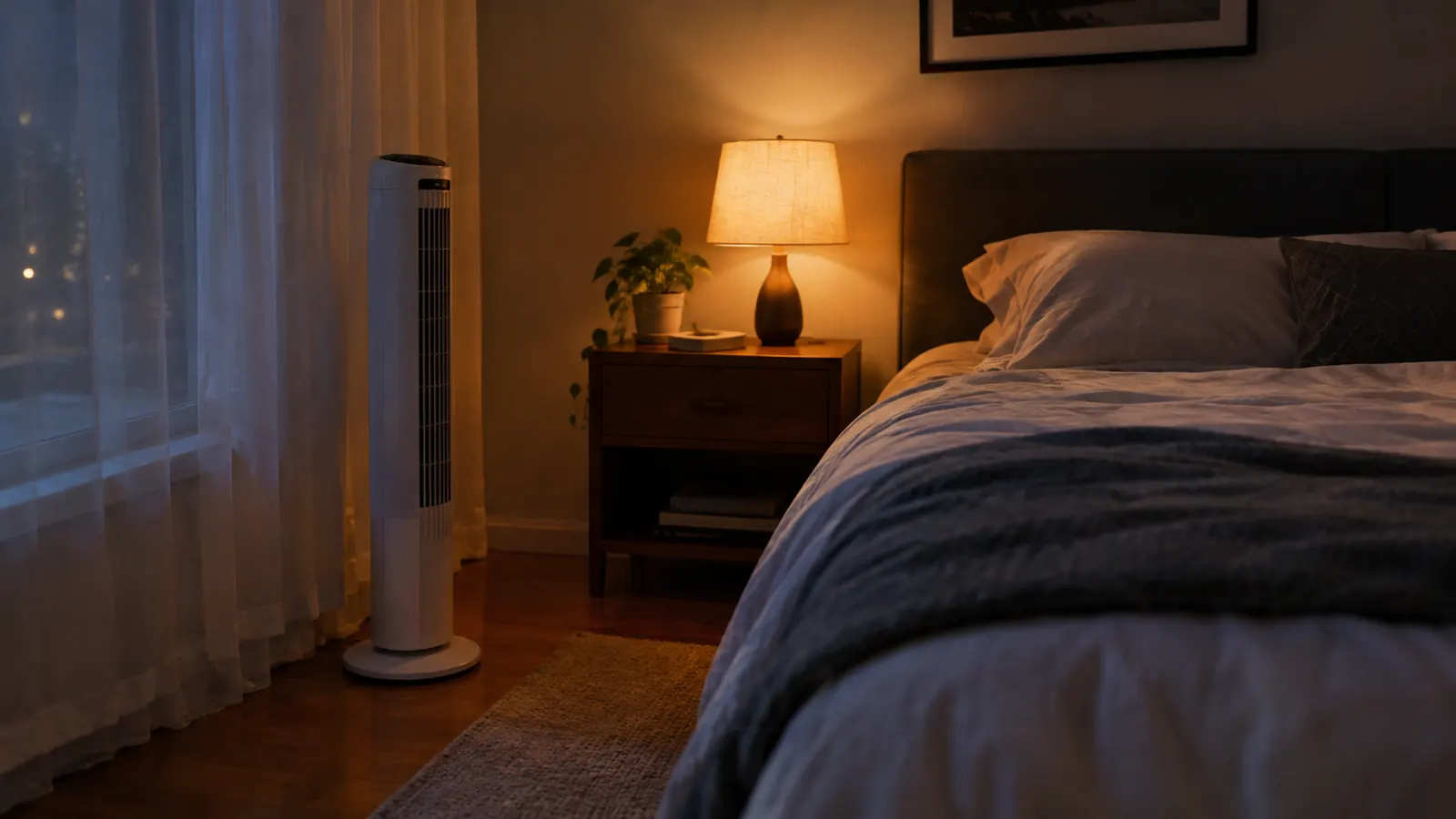
I know exactly why you are reading this at 11 p.m. with the sheets kicked to the foot of the bed. You are warm, you are tired, and you have already tried sleeping with one leg out from under the covers, which worked for about nine minutes. I am Paulette, and I have spent the last four months testing a Dreo tower fan in my own bedroom in Asheville, North Carolina, where the house was built in the 1950s and the west-facing bedroom holds every bit of afternoon heat it can collect. The night that finally pushed me to write this down was a Saturday in mid-July, when the bedroom still felt like the inside of a parked car at 10:40 p.m. and I had already kicked the covers off twice. By 2 a.m. I was lying on top of the sheet with the window open, the ceiling fan on high, and no idea what else to try. That was the night I started keeping notes on what actually worked. This guide is the five-step routine I have used ever since, in order, when the bedroom feels like a slow oven and I need to sleep.
Before we start, one honest note: a fan will not stop a hot flash, and I am not going to pretend it will. What it can do is keep air moving across your skin, pull the stale heat away from the bed, and make the room feel several degrees more comfortable so you can get back to sleep faster. If night sweats are disrupting your sleep most nights, please talk to your doctor. This is about making the bedroom cooler, nothing more.
The fan I keep beside my bed every night
The Dreo tower fan has 8 speeds, a remote, and a quiet enough low setting that I can run it all night without Dennis complaining. It stands on my side of the bed and does the job every single night.
Amazon Check Today's Price on Amazon →Step 1: Put the fan where the air can actually reach you
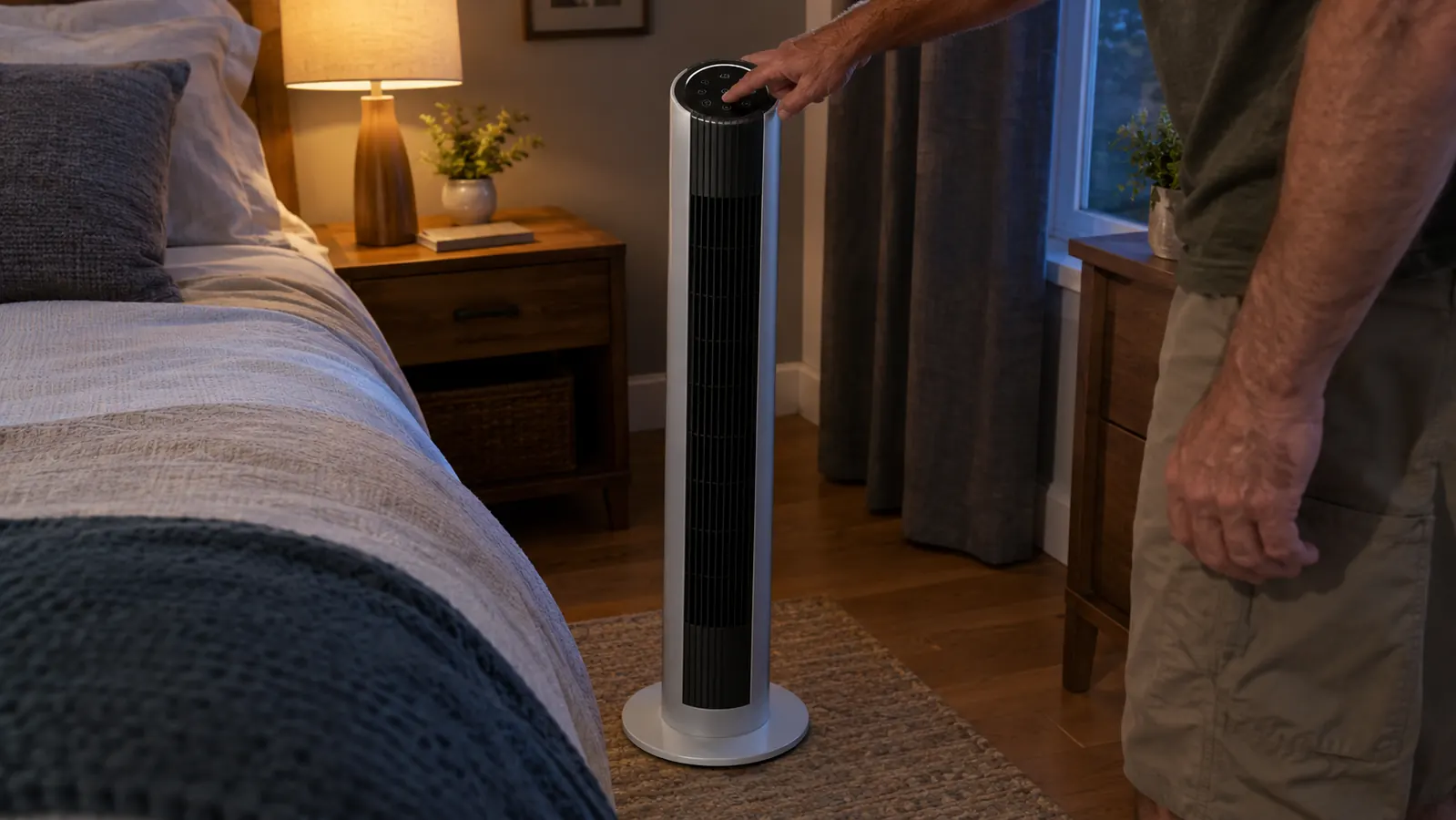
The biggest mistake I made at first was tucking the fan into the corner behind the bedroom door. It looked tidy and it did almost nothing, because the air stream hit the wall before it ever reached the bed. For three nights I lay there waiting for a breeze that never came, and I honestly started to wonder if I had wasted my money. Then I paid attention to what the fan was actually doing: it was pushing air into a corner where two walls met, and the air just swirled there. After a few sweaty nights I moved the Dreo tower fan to the floor on my side of the bed, about two feet from the mattress, angled slightly toward me. That single change did more than any setting on the fan itself. The Dreo is rated at 28 feet per second of air velocity, which sounds like a spec sheet until you feel how much air it moves from two feet away. The first night I placed it there, I was asleep about twenty minutes faster than I had been in weeks.
Tower fans are tall and narrow, which makes them easy to place close to the bed without taking up the space a box fan would. You want the air moving across your body, not straight down the middle of the room. If you share a bed, aim it at your own side and let your partner adjust their own blanket situation. Dennis runs cold and sleeps under a heavy blanket, so the fan is pointed at me, and we both sleep better.
If the fan has to sit farther away, point it at the foot of the bed rather than your face. Air moving over your legs and feet cools your whole body more evenly, and it is less likely to give you a dry throat by morning.
Step 2: Use the lowest speed that still moves air
Here is the counterintuitive part: more air is not always better. On the Dreo tower fan, speed 8 feels like standing in front of a small hurricane, and it is too much for sleeping. The air is loud, the sheets flap, and I wake up with a dry mouth. I learned this the hard way one night in early August, when I set the fan on speed 6 to prove that a higher setting would cool the room faster. At 2:15 a.m. I woke up with a parched throat, the fitted sheet pulled loose at one corner, and the curtain from the open window standing straight out. I fumbled for the remote, dropped it to speed 2, and was back asleep within ten minutes. What works for me is speed 2 or 3, low enough that the sound fades into the background but the air still moves across my skin.
The Dreo has 8 speeds, and the low end is where it earns its keep. On the lowest settings it is quiet enough that I forget it is running, which matters when you are trying to fall asleep and every little hum keeps you awake. I keep the remote on the nightstand so I can nudge the speed up or down without getting out of bed in the middle of the night.
If you are the kind of sleeper who gets cold at 2 a.m. after the room finally cools down, the remote is the whole point. You can drop the speed or turn the oscillation off without sitting up. I do this at least twice a week, and it is the difference between a full night and a 3 a.m. trip to the thermostat.
Step 3: Use oscillation to cool the whole room, not just your face
Oscillation gets a bad reputation because people assume it just means the fan is waving back and forth. But for a hot bedroom, that sweeping motion is exactly what you want. Instead of one narrow stream of air hitting your face all night, the fan distributes the moving air across the whole room, which keeps the space from feeling stuffy and stagnant. I noticed the difference most clearly during a stretch of ninety-degree nights in late July. With the fan fixed on me, the far side of the bed stayed warm and the air near the dresser felt dead. With oscillation on, the whole room felt like it was breathing, and Dennis stopped complaining that his side of the bed was stuffy.
I run the Dreo tower fan on oscillation for the first hour or two of the night, while the room is still holding the day's heat. The moving air pushes the warm pocket out from around the bed and keeps the whole room feeling fresher. Once I am actually sleepy, I often switch it to a fixed position aimed at my side of the bed, because a steady breeze is more soothing than a fan that keeps sweeping past me.
The Dreo's oscillation is wide enough to cover the room without making the motor work harder, and the remote makes it easy to switch modes in the dark. If you wake up hot at 3 a.m., you can turn oscillation back on without fumbling for a switch.
Step 4: Pair the fan with the right bedding and pajamas
A fan can only do so much if you are sleeping under a heavy comforter in flannel pajamas. I learned this the hard way one night in the first week of June, a few days after I started using the fan. My new pajamas had not arrived yet, so I was still in an old cotton T-shirt under our heavier quilt, and I woke up at 1:30 a.m. with the back of my neck damp. I blamed the fan, set it on speed 5 for the rest of the night, and got almost no sleep. The next day I took a hard look at what I was actually wearing and sleeping under, and I made some changes.
Now I sleep on Bedsure PureWoven sheets, which are made from rayon derived from bamboo, and they breathe far better than the cotton sheets I used before. I also wear a Joyaria cooling pajama set in navy, a bamboo viscose long-sleeve top with pants, and I swapped the October quilt for a lighter blanket. Together with the fan, these keep me comfortable without piling on and kicking everything off at 2 a.m. Dennis still uses his heavy blanket, which is fine, because the fan is pointed at my side.
The point is not that you need to buy new sheets and pajamas. The point is that the fan works with what you are wearing and sleeping on. If you are sleeping in sweatpants under a quilt, the fan will move the air and you will still be warm. Light, breathable layers let the moving air do its job.
Step 5: Open a window or door to give the fan fresh air to work with
A fan recirculates the air in the room. It does not create cool air out of nowhere. If the bedroom is hot and stuffy, the fan will move that same warm air around and it will still feel warm. The fix is to give the fan a source of cooler air, which usually means opening a window or leaving the bedroom door open so air can move between rooms.
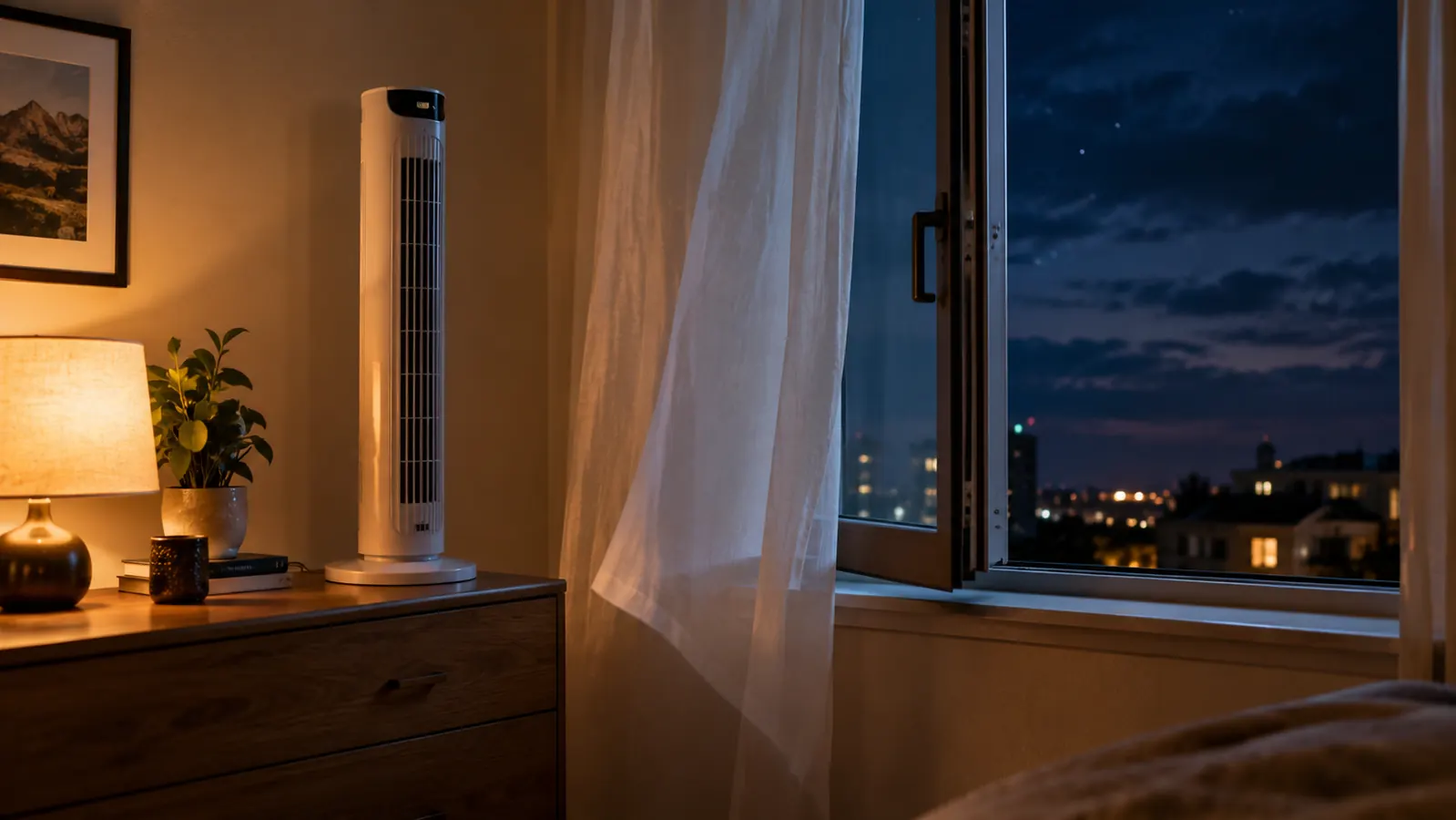
In my house, the bedroom faces west and holds the afternoon heat, so on summer nights I open the window a few inches and angle the Dreo tower fan toward it. That pushes the warm air out and pulls the cooler night air in. If you have central air, like I do, you can also leave the bedroom door open and run the fan near the doorway to pull the cooler hallway air into the room. One night in late August I closed the window because a thunderstorm was moving in, and within an hour the room felt close and heavy even though the fan was running on the same settings that had felt fine the night before. The fan was doing its part. It just had no cooler air to work with.
This is the step most people skip, and it is the one that makes the biggest difference on the hottest nights. The fan is not magic, but it is very good at moving air from where it is cool to where you are hot.
What Else Helps
Beyond the five steps above, a few small things make the bedroom feel cooler without any extra gear. I keep the curtains closed during the day so the west sun does not bake the room, and I open them at night when the temperature drops. On the hottest afternoons I close them by 2 p.m., because once the sun hits the window frame, the room is already on its way to hot. I also use a Linenspa 2 inch gel memory foam topper on our mattress, which sleeps cooler than the old mattress surface did. And I keep a glass of ice water on the nightstand for the 3 a.m. wake-up. I have learned to sip it instead of getting up and wandering to the kitchen, because once I am up, I am awake. I also sleep on a QUTOOL cooling pillow with shredded memory foam. It came with more fill than I wanted, so I unzipped it and took out a handful on my side, and it sleeps noticeably cooler than the old pillow did. None of these are cures for night sweats, but they all make the room a more comfortable place to sleep, and that is the goal.
The single biggest change was moving the Dreo tower fan from the corner to the floor beside my side of the bed. Same fan, same settings, completely different night.
A cooler night starts with the fan beside your bed
The Dreo tower fan has been on my side of the bed every night for four months. It is quiet, it has a remote, and it makes the bedroom feel cooler without turning the whole house into an icebox.
Amazon Check Today's Price on Amazon →