
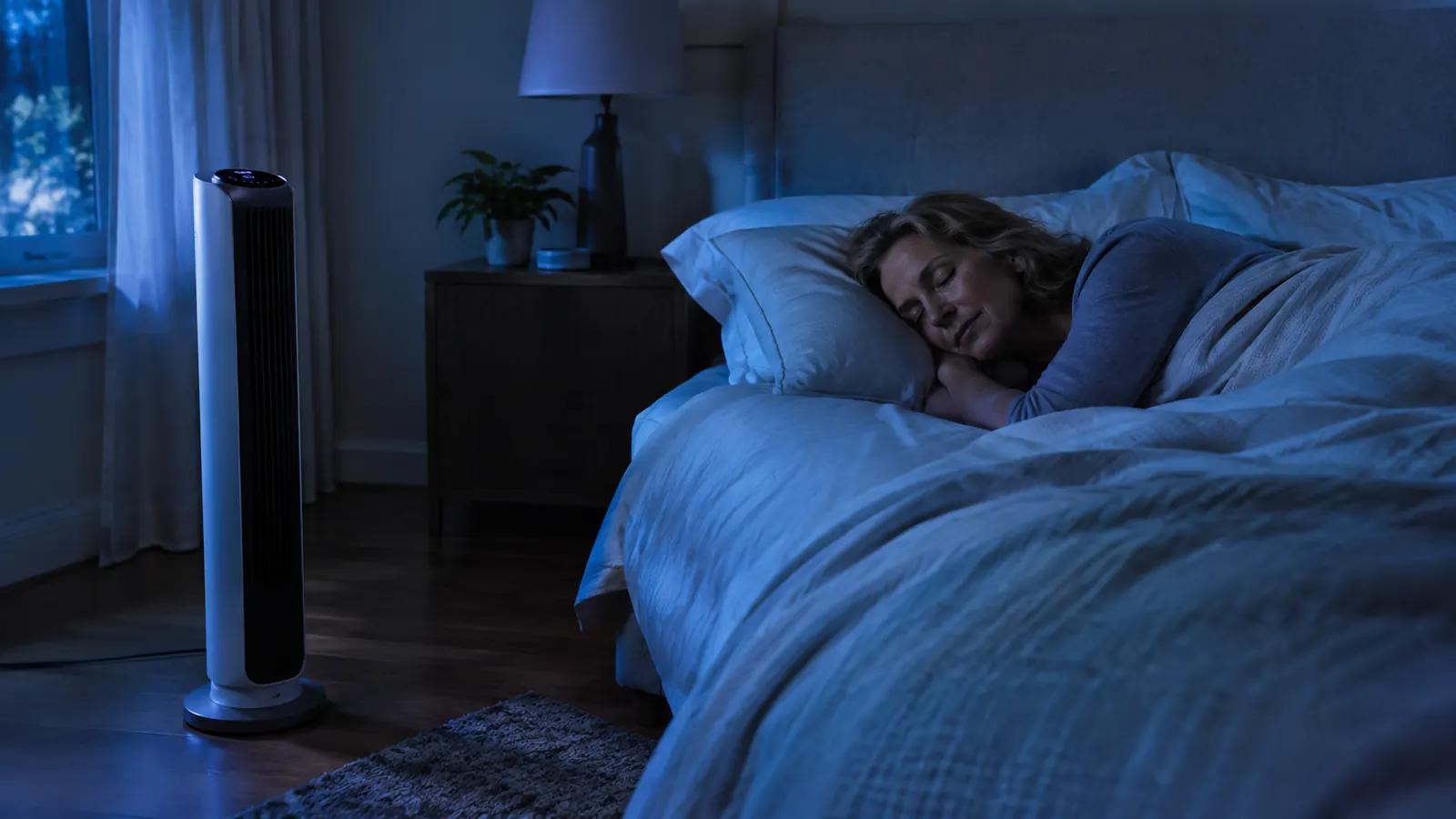
The 3 a.m. wake-up is the part nobody warns you about. You surface with your heart going a little faster, the sheets twisted, the back of your neck damp. You check the clock, kick off the covers, and lie there trying to decide whether to drag yourself to the thermostat. I know the routine because I lived it for the better part of three years. My name is Paulette, I am 54, and I work as a middle school librarian in Asheville, North Carolina. My night sweats started when I was about 51, and for a long time I treated my bedroom like a problem to be solved at 3 a.m.
What finally helped was not a fancier mattress or a pile of supplements. It was a Dreo tower fan that now stands on my side of the bed. I have used it every night for about four months, since early summer, and it has changed the part of the night I can actually control: the air moving across my skin. The fan has eight speeds, a remote, and an oscillating head, and it is quiet enough that my husband Dennis, who runs cold and sleeps under a heavy blanket, does not complain about it. This is not a medical fix. I talked to my own doctor about my symptoms, and nothing here replaces that conversation. But for the comfort part of the night, the Dreo fan has earned a permanent spot in our bedroom.
The Fan That Shortened My 3 a.m. Wake-Ups
Ten practical reasons this quiet tower fan earned the spot beside my bed, from the remote I can work without sitting up to a speed setting Dennis can live with.
Amazon Check Today's Price on Amazon →It Moves Air Without Sounding Like an Engine
The old box fan we used to drag out in July sounded like a small plane. I could hear it from the hallway. The Dreo fan is a different category of quiet. I can fall asleep with it running and not notice it until I need it. When a night sweat hits, the air is there, moving across my damp skin, and the sound does not add to the 3 a.m. chaos.
The Oscillation Reaches Me Without Freezing Dennis
Dennis sleeps with a heavy blanket and the thermostat set the way he likes it. I sleep with one leg out from under the covers. We are a thermostat argument waiting to happen. The fan's oscillation solves it. It swings across the bed, so I get moving air on my side, and he gets a gentle pass, not a blast. I point it low on my side, and the breeze finds me without turning his side of the bed into a wind tunnel.
The Remote Means I Never Fully Wake Up
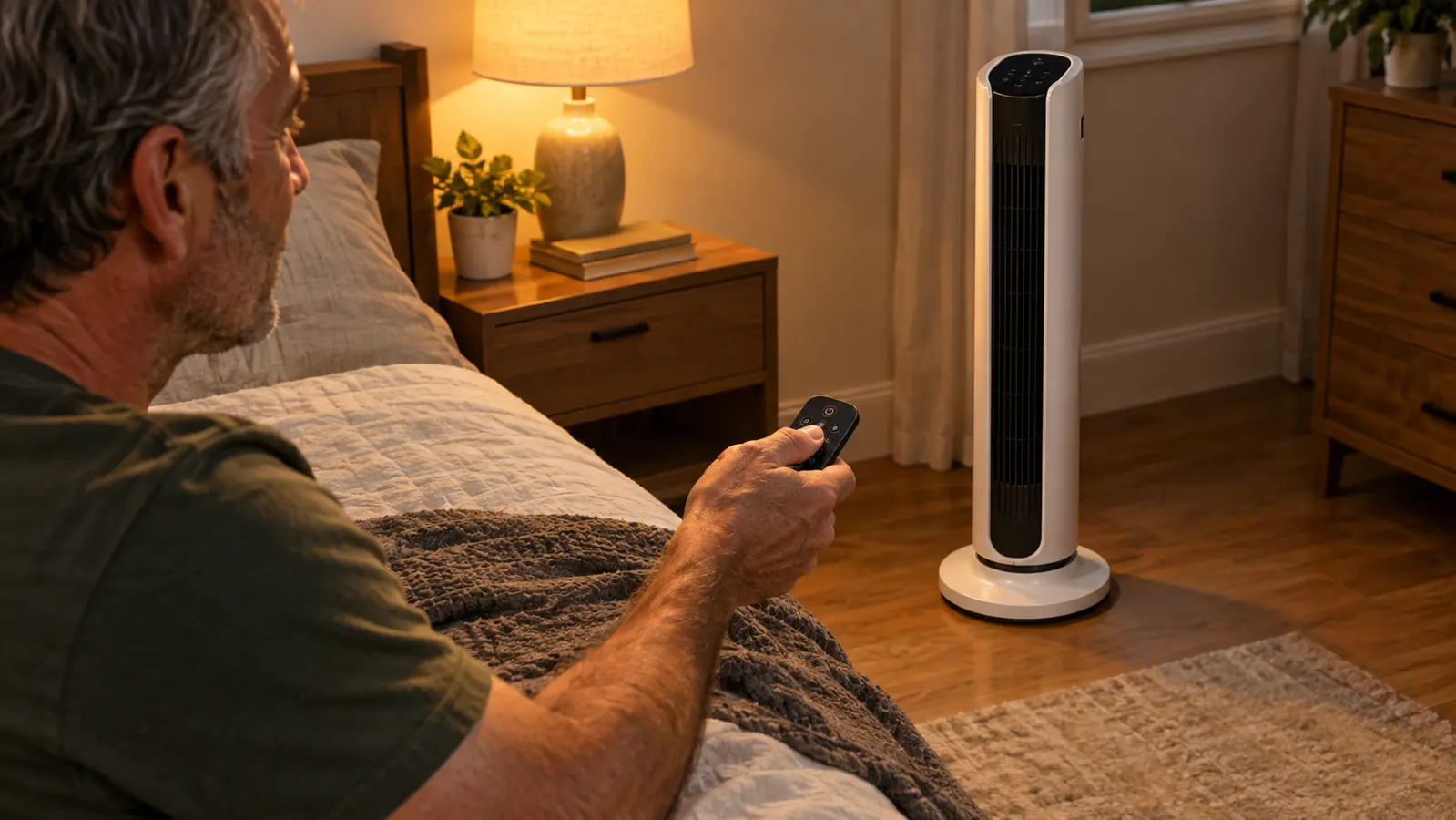
The worst part of a night sweat is not the sweat. It is the part where you sit up, fumble for a lamp, and wake yourself all the way up. I keep the Dreo remote on my nightstand. When I surface at 2 or 3 a.m., I can bump the speed up or turn the oscillation on without sitting up and without turning on a light. Staying half-asleep is the difference between being back under in ten minutes and being up for an hour.
Eight Speeds Means a Setting for Every Kind of Night
Some nights I need barely any air. Some nights, the ones after a hot day when the west-facing bedroom has held the afternoon heat, I need everything the fan has. Eight speeds covers both. On a cool night, speed two is enough. On a bad night, I can push it higher and the 28 feet per second rated air velocity actually reaches across the bed. Having the range means I do not have to settle for one setting that is wrong half the time.
The Timer Keeps It From Becoming an All-Night Gale
I was skeptical about the timer at first. Why would I want the fan to turn itself off? Then I used it. I set it for an hour or two when I get into bed, and it cools the space around me while I drift off. When it stops, the room is already comfortable and I am asleep. It also means I am not running a fan all night in a room where Dennis is already cold. The timer is now a feature I use on most cooler nights.
It Works With the Cooling Bedding I Already Own
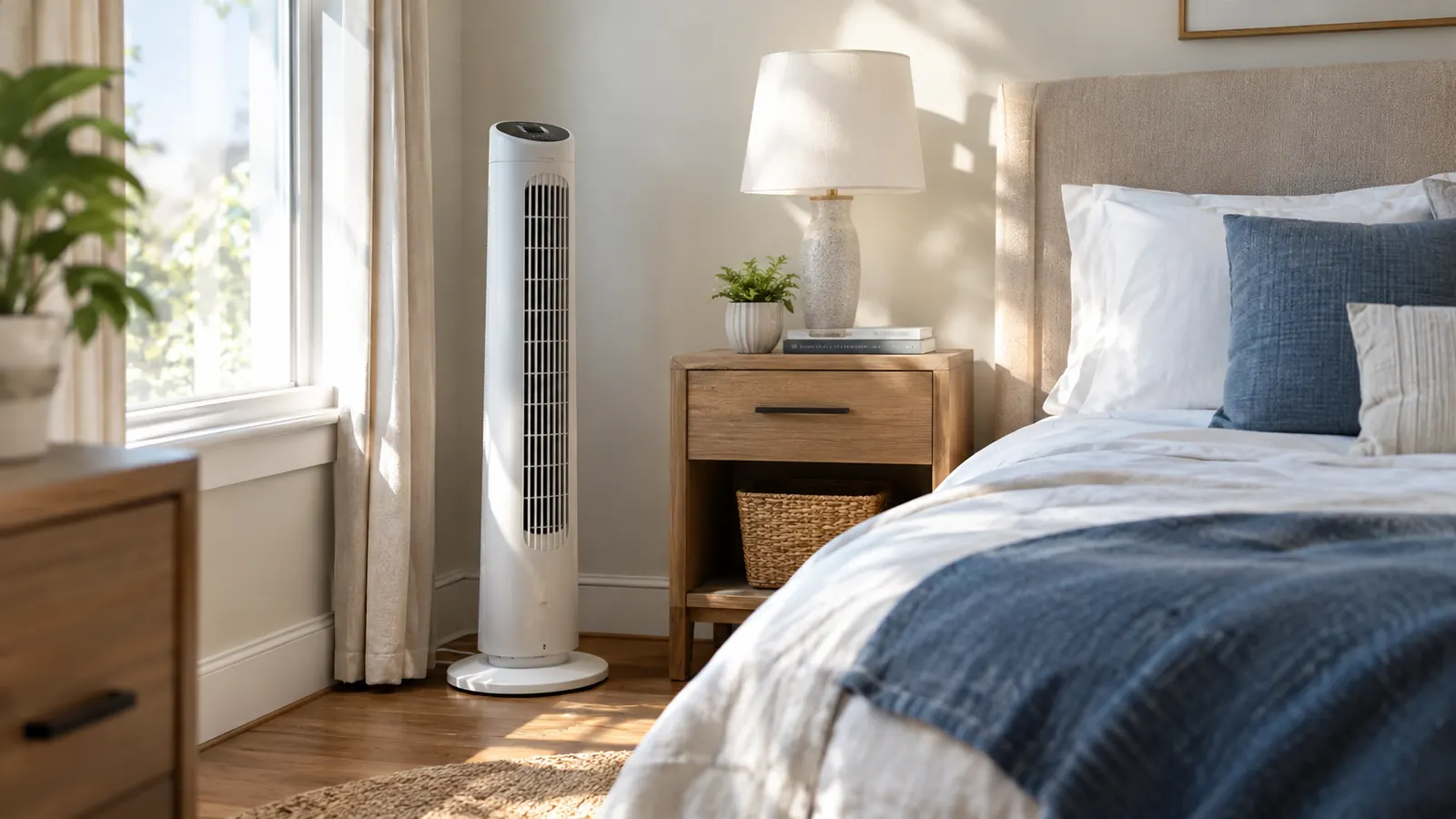
The fan did not replace my cooling sheets or my adjustable pillow. It works alongside them. The sheets take the heat off my skin, the pillow lets me adjust the fill, and the Dreo fan keeps the air moving so I do not feel like I am lying in a pocket of still, warm air. The combination is what helped, not any one piece. I mention this because nobody needs to buy a whole new bedroom at once. The fan was the piece that tied it together.
It Cuts the Time It Takes Me to Cool Back Down
The worst part of a night sweat is the minutes after, when you are damp and wide awake and the room feels ten degrees hotter than it is. The moving air from the fan shortens that window. Instead of lying there waiting to cool off, I feel the breeze on my skin right away, and I can settle back into the pillow. I am not going to claim it stops night sweats, because nothing I own does that. But it makes the recovery part faster, and faster recovery means more sleep.
The Slim Footprint Fits a Crowded Bedroom
Our bedroom is a normal 1950s ranch bedroom, which means no extra floor space. The fan stands on my side of the bed, tucked between the nightstand and the wall, and it does not crowd the room or block the walkway. It is taller than I expected but narrow, so it lives where I need it without rearranging the furniture. That matters when you are 54 and you have no interest in redesigning your bedroom around a fan.
It Makes the Cool Air From the Thermostat Actually Reach the Bed
We keep the thermostat around 68 at night, but the cool air does not always make it across the room to the bed, especially after a hot day. The fan pulls that cool air toward me instead of letting it pool near the vent. I am not going to quote a temperature drop, because I did not measure one. The difference between lying in still air and lying in moving air is noticeable, and on a sticky July night it is the difference between a short wake-up and a long one.
It Is the Honest Kind of Help, and That Is Why I Trust It
Nothing in this article is going to tell you that a fan cures hot flashes, because it does not. I talked to my doctor about my symptoms, and that conversation matters more than any product. What the Dreo fan does is simpler and still worthwhile: it makes the bedroom a more comfortable place to ride out the night. No hype, no promises, just moving air at the right speed when I need it. For a woman who is tired of being sold cure-alls, that honesty is the whole appeal.
What I'd Skip
If you are looking for a product that will stop hot flashes or fix your sleep, skip this fan and talk to your doctor first. I say that plainly because I wish someone had said it to me. The fan is for comfort and for the sleep environment, and it is very good at that. It is also not for someone who hates any moving air at night, or who wants a tiny personal desk fan, because this one is a full-size tower fan that needs a spot on the floor. If you already know you want a quiet, adjustable tower fan for your side of the bed, this one is worth a look. If you are hoping a fan will do the work your doctor should be doing, it will disappoint you.
The night I first used the remote without sitting up, I was back asleep in minutes instead of lying there for an hour.
A Calmer Night Starts With Moving Air
If you are waking up hot and wide awake at 3 a.m., the Dreo tower fan is a practical, honest place to start. It is quiet, adjustable, and it has earned its spot on my side of the bed for four months straight.
Amazon Check Today's Price on Amazon →