
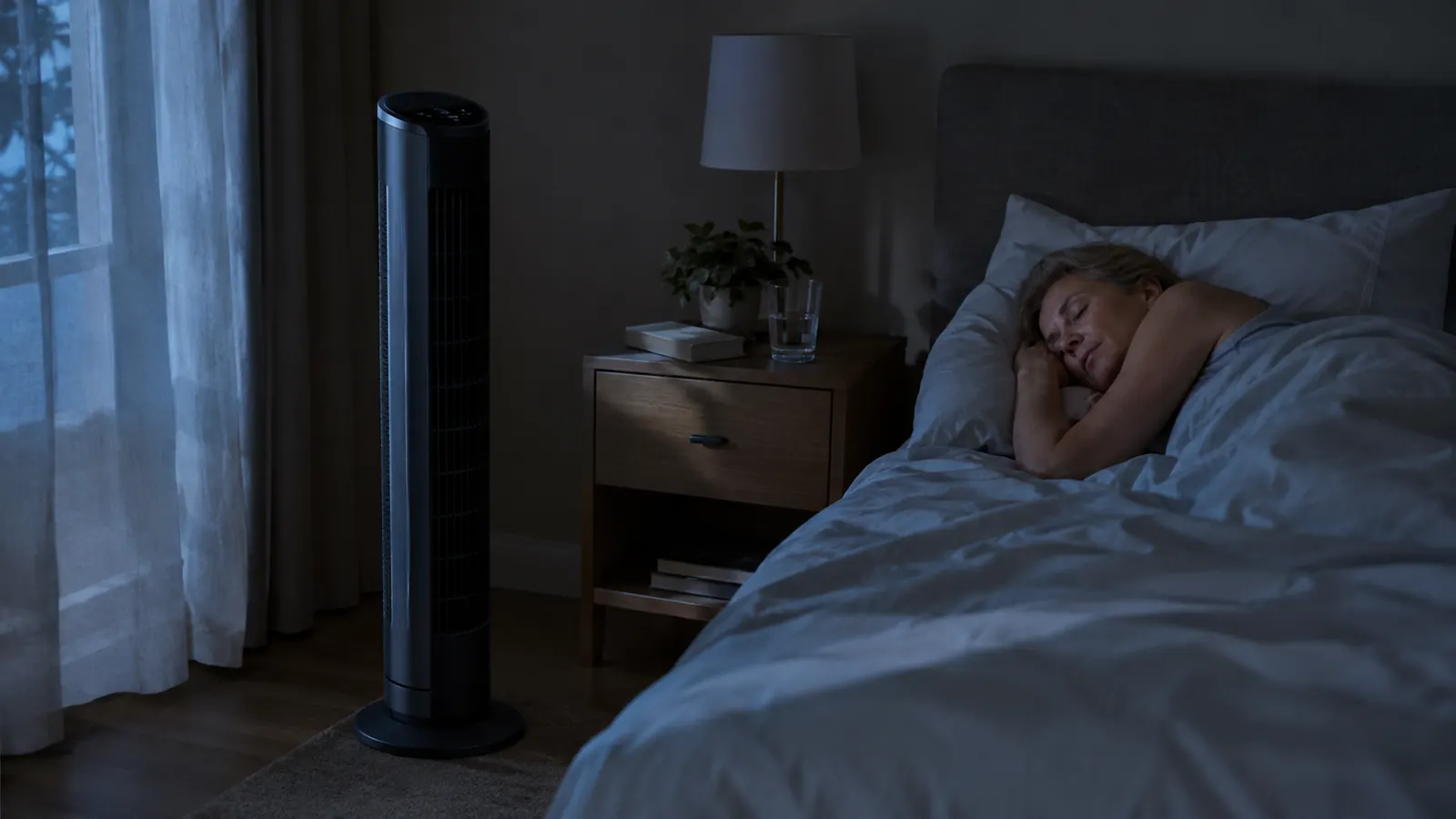
Somewhere around 3 a.m., the blanket comes off. It doesn't matter that the thermostat is set to 68, that the room is dark, or that I did everything right before bed. My body has its own schedule, and for the past three years that schedule has included waking up hot, sweaty, and wide awake while Dennis sleeps under his heavy blanket without a care. I tried everything short of a new mattress. Then I put a Dreo tower fan on my side of the bed, and I dug our old box fan out of the garage to compare them honestly. This is that comparison.
The short answer: for sleeping, the Dreo wins, and in my room it wasn't close. The box fan moves more air, full stop. But more air and better sleep are two different things. The Dreo puts a focused stream of air on my side of the bed, oscillates so I stay covered when I turn over, and lets me change speeds with a remote I keep on the nightstand. The box fan is louder, blasts everything within five feet, and forces me to get out of bed to adjust it. If you're shopping for cooler nights, here's the honest breakdown.
How I Tested Both in My Bedroom
Our bedroom is the hottest room in the house. It faces west, so it soaks up afternoon sun all day, and by bedtime the walls are still holding heat. I keep the central air at 68 at night, which helps, but it doesn't fix the 3 a.m. wake-up. So I set up a fair test: two weeks with the box fan on my side of the bed, then the Dreo in the same spot for the rest of the summer. Same room, same thermostat, same queen bed, same me.
One confession: the box fan is not a fancy fan. It's a basic 20-inch model we've had for years, the kind with a dial and a metal grille. That's the point, though. Most people comparing a tower fan to a box fan aren't comparing two premium products. They're wondering whether the extra money for a tower fan is worth it over the fan they already own or the cheap one at the hardware store. That's the comparison I actually ran.
| Dreo Tower Fan | 20-Inch Box Fan | |
|---|---|---|
| Noise at night | 8 speeds, quiet at the low end, built for a bedroom | Loud on high, a constant hum even on low |
| Air movement | Focused 28 ft/s stream, a smaller column of air | Moves far more total air across the room |
| Aiming at the bed | Oscillates side to side to cover your side of the bed | Broad blast you angle by hand, strongest close up |
| Adjusting in the dark | Remote on the nightstand, 8 speeds, no getting up | You get up and turn a dial |
| Floor space | Slim tower that tucks beside the nightstand | Big square that needs floor or window space |
| Window use | Not built to sit in a window frame | Made to fit a window and pull in cool night air |
| If something breaks | Costs more to replace | Cheap enough to replace without a second thought |
| Cleaning | Dust gathers inside the tower, harder to reach | Front grille pops off, blades wipe clean |
Where the Dreo Wins
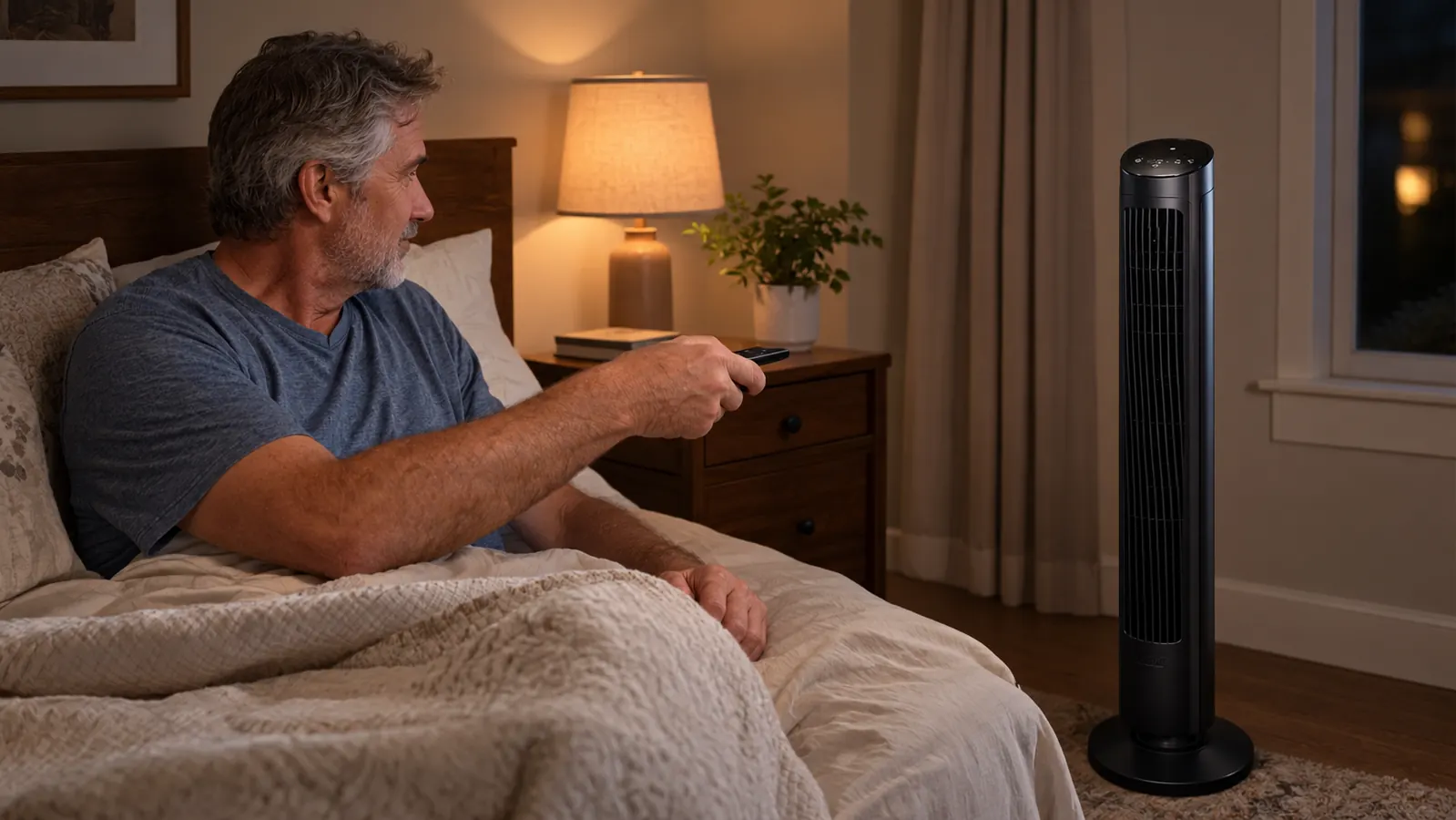
The biggest difference shows up at 3 a.m., which is the whole point. When I wake up hot, I want two things: cool air on my skin and to go back to sleep. The Dreo's remote sits on the nightstand, so I can bump it up a speed without sitting up, without turning on a light, without waking Dennis. With the box fan, getting more air meant swinging my legs out, crossing the room, and turning a dial, and by the time I got back under the sheet I was fully awake. That alone decided it for me.
The Dreo also wins on the shape of its airflow. It oscillates, so the stream sweeps across the bed and finds me whether I'm on my side or turned over. It's quiet enough at the low end that it doesn't add a hum to the room, which matters when you're trying to drift off. And because it's a slim tower, it stands next to the nightstand without eating floor space in a room that doesn't have any to spare. In a small bedroom, that footprint is a real advantage.
Where a Box Fan Wins
I'm not going to pretend the box fan has no case, because it does. It moves a serious amount of air. A 20-inch box fan pushes a broad, powerful blast that you can feel across the room, and on the hottest nights, nothing beats standing in front of it. If your problem is the whole room being stuffy, the box fan fixes that faster than any tower fan I've tried. It's also the fan I'd grab for a stuffy hallway or a hot kitchen while I'm cooking.
The box fan also does something the Dreo can't do: it fits in a window. On cool nights, you can set it in the window frame to pull in outside air, which is the simplest kind of air conditioning there is. And if something breaks, you shrug and buy another one. There's no remote, no circuit board, no oscillation motor to fail. It's a simple machine, and simple machines are easy to live with. For a garage, a workout room, or a window on a cool night, I'd pick the box fan every time.
The box fan moved more air. The Dreo moved the air where I needed it, and I could change speeds without my feet touching the floor.
The fan that puts the air on your side of the bed
After a summer with both, the Dreo is the one that stays by my bed. If you're waking up hot and tired of getting up to adjust a fan, it's worth a look. Check today's price on Amazon and see if it fits your nightstand.
Amazon Check Today's Price on Amazon →What the 3 a.m. Test Looked Like
The honest test happened on the nights I didn't plan it. I'd wake up at 3 a.m. with the sheet kicked off and that familiar flush of heat. With the box fan, the sequence was: realize I'm hot, lie there hoping it passes, give up, get up, walk across the room, turn the dial, stand in the blast for a minute, walk back, and try to convince my brain it's still nighttime. By then I was awake enough to start planning tomorrow's to-do list. That's a bad place to be at 3 a.m.
With the Dreo, the sequence is: wake up hot, reach for the remote on the nightstand, tap it up one speed, feel the air find my shoulder, and close my eyes. I don't turn on a light. I don't wake Dennis. I'm usually back to sleep before I could have even gotten out of bed with the box fan. That's the whole review in two scenes. If your nights look like the first scene, you already know which fan you need.

How I Set It Up for Nighttime Use
The Dreo lives on my side of the bed, about three feet from the headboard, angled so the airflow crosses the pillow without blasting my face all night. I run it on a low speed with the oscillation on, which is enough to keep my shoulder and neck cool without turning the bed into a wind tunnel. Dennis, who runs cold and sleeps under a heavy blanket, says he can barely hear it and doesn't feel it at all. That's the setup that worked for us. If you share a bed with someone who runs cold, aim the oscillation to favor your side. The Dreo lets you set it and forget it, which is the whole point.
One thing I learned the hard way: don't aim a tower fan straight at your face. The focused stream is strong, and after two nights I had a dry throat and a stiff neck. Angling it so the air hits your shoulder or chest first makes a huge difference. Also, keep the remote somewhere you can find it in the dark. I keep mine on the nightstand next to my water glass, which sounds obvious, but in the first week I lost it between the sheets twice and had to get up anyway. Lesson learned.
Who Should Buy Which
Buy the Dreo if you sleep hot, if your partner runs cold, or if you're the one who wakes up at 3 a.m. needing air. The remote, the quiet low speeds, and the aimed oscillation are made for exactly that scenario. It's also the better choice if your bedroom is small, because it disappears next to the nightstand, or if you want a fan that can sweep the whole room during the day and then go quiet at night. That dual personality is hard to beat.
Buy a box fan if you mostly need to move air in a bigger space, if you want something to pull cool air in through a window, or if you simply don't want to spend much on something that might end up in the garage by September. And be honest about your habits. If you're the kind of person who will never use a remote and just wants one dial and one switch, the box fan is the more practical buy. There's no shame in that.
And if you're buying for a partner who sleeps hot, the remote is the detail that will make you a hero. Being able to hand them a small remote and say 'you control the air on your side' costs nothing in effort and changes the whole dynamic of a shared bed. The box fan has no such moment. It just sits there, loud and unbothered, waiting for someone to get up and turn the dial.
The Part Nobody Warns You About
Two honest complaints about the Dreo before you buy. First, it collects dust. Tower fans have grilles and fins that gather every bit of lint in the room, and cleaning inside one takes more work than popping the front off a box fan. I run a dry cloth over the fins every couple of weeks, and it's fine, but it's a chore the box fan doesn't have. Second, the oscillation motor is one more thing that can break. Mine has been fine for four months, but a box fan has almost nothing to fail.
The other thing worth knowing: neither fan fixes the underlying problem. I still wake up hot some nights. The Dreo makes those nights shorter and easier to get back to sleep, because the air is already there and I can adjust it without fully waking up. But if night sweats are disrupting your sleep most nights, that's a conversation for your doctor, not a fan review. A good fan changes the room. It doesn't change your hormones, and anyone who tells you otherwise is selling something.
One last note: a tower fan is not a white noise machine. The box fan, for all its noise, does a decent job of covering up neighborhood sounds, and some people sleep better with that. If you're one of them, you might miss the hum. I don't, but I know plenty of people who can't sleep in silence. That's a genuine preference, and it might be the deciding factor for you.
One fan stays by the bed. It's the Dreo.
If you're comparing a tower fan to the box fan in your garage, the answer depends on your room and your habits. For a hot sleeper in a small bedroom, the Dreo does the job the box fan can't: quiet, aimed air you can adjust without leaving bed. Check today's price on Amazon to see if it's right for your nightstand.
Amazon Check Today's Price on Amazon →