
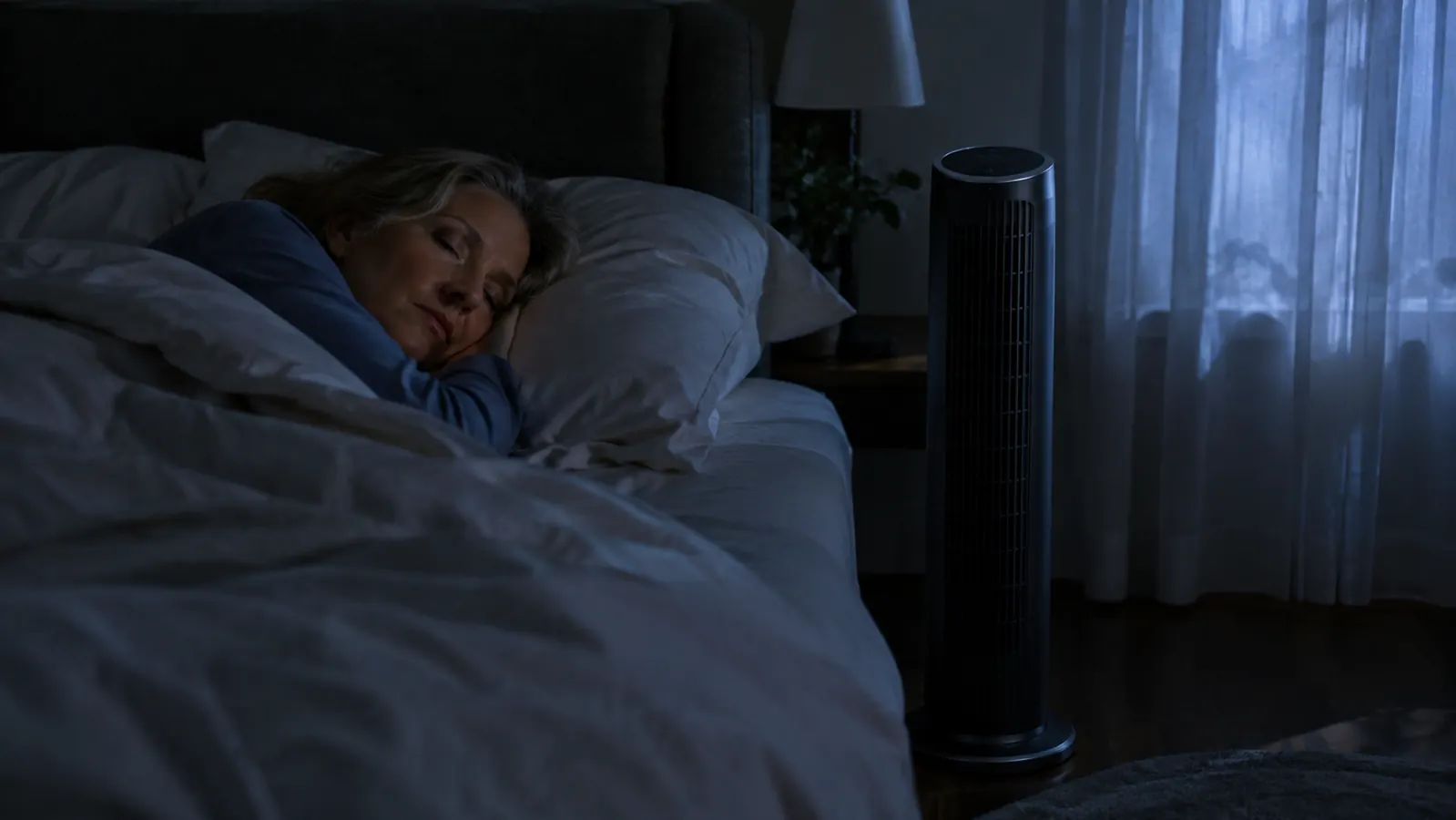
Three in the morning and I am awake again, the sheet twisted around my legs and the back of my neck damp. This is the part of menopause that nobody puts on a greeting card: you are bone tired, your husband is dead asleep under a blanket he refuses to give up, and your own body has decided to run its own heat wave. For months I tried every free fix I could think of. I cracked the window, slept with one foot out from under the covers, and kept a glass of ice water on the nightstand. Then I bought the Dreo tower fan, mostly out of pure desperation, and it has stood on my side of the bed every single night since early summer.
Before you keep reading, here is what this review is and is not. I am not a doctor, I have not cured my own hot flashes, and no fan on earth is going to switch off your hormones. What I can honestly tell you is what four months of real nights have been like with this fan running beside me: which settings I actually reach for, what the remote is like at 2 a.m., how loud it really is, and whether Dennis, who runs cold and sleeps under a heavy blanket, has complained even once. That last part matters more than you might think.
The Quick Verdict
A quiet, adjustable tower fan that made my 3 a.m. wake-ups shorter and my return to sleep faster. It will not stop your hot flashes. It will make the nights around them easier to live with.
Amazon Check Today's Price →The fan that finally ended the 3 a.m. sheet twist
If you are waking up hot and tired of choosing between a stuffy room and a noisy fan, this is the one I kept running every night for four months. Check today's price on Amazon.
Amazon Check Today's Price on Amazon →How I've Used It
The fan lives on the floor on my side of the queen bed, about a foot and a half from the mattress, and it runs from about ten at night until morning. I do not aim it at my face. I set it low and let it oscillate, and it keeps a slow current of air moving across the whole bed. That is the thing nobody tells you about night sweats: the problem is often not that the room is hot, it is that the air goes dead around you and your skin cannot shed heat. Moving air changes that, and it changes it fast.
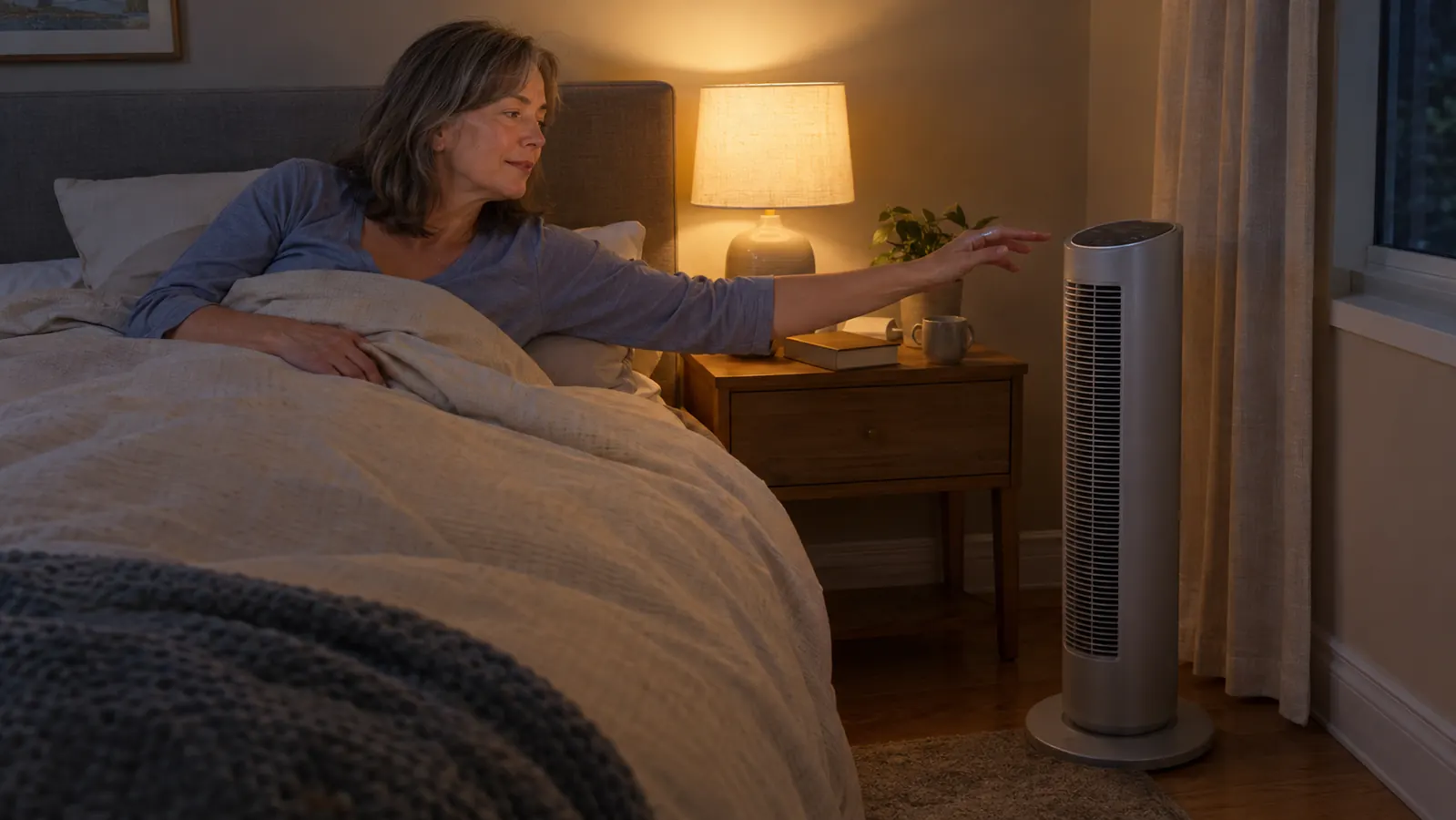
I use the remote more than I ever expected. When a hot flash hits at 2 a.m., the last thing I want to do is sit up, fumble for a dial, and wake myself the rest of the way. The remote lives on my nightstand, and I can bump the fan up two speeds without opening my eyes. Being able to adjust it without sitting up has saved me more full awakenings than I can count.
Four months in, the routine is settled. Dennis still sleeps with his heavy blanket, and the fan does not bother him at all. That genuinely surprised me. He runs cold, he hates drafts, and I was sure he would complain by the third night. Instead, the first thing he said was that he could finally hear himself think, because the fan covers the little noises the house makes at night. I married a man who notices everything, so that counts as a glowing review.
The first week took some getting used to. I had spent years sleeping under a ceiling fan, and I was not sure a floor fan would do the same job. It does, but differently. A ceiling fan stirs the air above you. This one sends a steady current along the bed, which is exactly where I need it. Within a few nights I stopped reaching for the ceiling fan switch myself, and these days only Dennis turns it on, on his side.
What Eight Speeds Actually Feel Like
I counted the speeds because I am that kind of person. There are eight, and they are not eight versions of the same breeze. The bottom end is barely there, a whisper of air you only notice when you stop moving, and that is what I use on cooler nights. Speed three is my everyday setting, strong enough to feel on my arms and chest without blowing the papers off the nightstand. I have never needed anything above five in the bedroom, but the higher speeds earn their keep on summer afternoons when the west-facing bedroom turns into a little oven.
Twenty-eight feet per second is the number on the box, and I am not going to pretend I measured it with a stopwatch. What I can tell you is that from three feet away on speed eight, this fan moves air like a much bigger machine. On the worst evening in August, I pointed it at the bed from across the room and the sheets stopped sticking to my legs within a few minutes. That is the practical version of the spec sheet, and it is the version that matters.
Oscillation is the feature I did not think I would care about. My old box fan just sat there and blew one stripe of air across one side of the bed, which meant either Dennis got everything or I did. The Dreo swings slowly through a steady arc across the bed, and it does not click or grind when it turns. That was my biggest fear about an oscillating fan, and four months in the motor still starts and stops smooth as butter.
The Quiet Claim, Tested by a Light Sleeper
This is the part I was most skeptical about, because every fan on the internet says it is quiet. Quiet usually means loud enough that you have to turn up the television. The Dreo is genuinely different on the low speeds. On one and two, I have to put my hand in front of it to confirm it is running. On three, which is where I keep it most nights, it is a soft white noise, the kind that helps me drift off instead of keeping me up.
The higher speeds have more presence, but it is air noise, not motor noise. There is no high-pitched whine, no rattling base, no hum that changes pitch when the head rotates. My ceiling fan is louder than this thing on speed three. That matters at 3 a.m., when every little sound feels like it is happening right inside your skull.
And the noise it makes covers the good kind of sound. Dennis noticed it before I did. The house settling, the refrigerator, the distant road noise, all of it blends into one steady hush. If you share a bed with someone whose small noises keep you up, a fan like this does double duty.
The Remote, the Light, and Other Small Things
The remote is small, flat, and it has a magnet in it, which I did not expect. It sticks to the side of the fan, so it has a home that is always within reach in the dark. That sounds like a gimmick until you remember how many remotes live in a junk drawer, useless. This one has never once gone missing, and for a 2 a.m. user, that is the whole ballgame.
Now the honest complaint. The control panel lights up when you touch the fan or the remote, and it stays lit for a few seconds. In a dark bedroom, that little glow registers behind your eyelids. It does not bother me much, but Dennis, who can sleep through a fire drill yet notice a single photon, mentioned it twice. If you need total darkness, you will either get used to it or cover the panel with a bit of tape. I will leave that call to you.
There is a timer, which I set on cooler nights so the fan winds down before morning, and a sleep mode that slowly drops the speed on its own. I tried sleep mode exactly once and woke up hot at 4 a.m., so I stopped. Give me the steady low speed and let me be the one who decides when it is time to turn up the air.
The controls on the fan itself are simple enough to use in the dark, which I appreciate, but the remote is better, so the panel mostly goes untouched. There is a button for oscillation, a button for the timer, and a big power button. I have pressed the wrong one exactly once, at 2 a.m., and accidentally turned the oscillation off. That is the extent of my complaints about the buttons.
How It Changed the Bedroom, Not the Menopause
Here is the honest summary of four months. The Dreo did not stop my hot flashes. Nothing has, and I have stopped expecting any product to. What it did is change what happens after a hot flash. Before, I would wake up soaked, throw off the covers, and lie there in my own heat for twenty minutes trying to get back to sleep. Now I wake up, tap the remote up two speeds, feel the air move across my skin, and usually drift off again in a few minutes. That is not a cure. It is a real improvement in the quality of my nights.
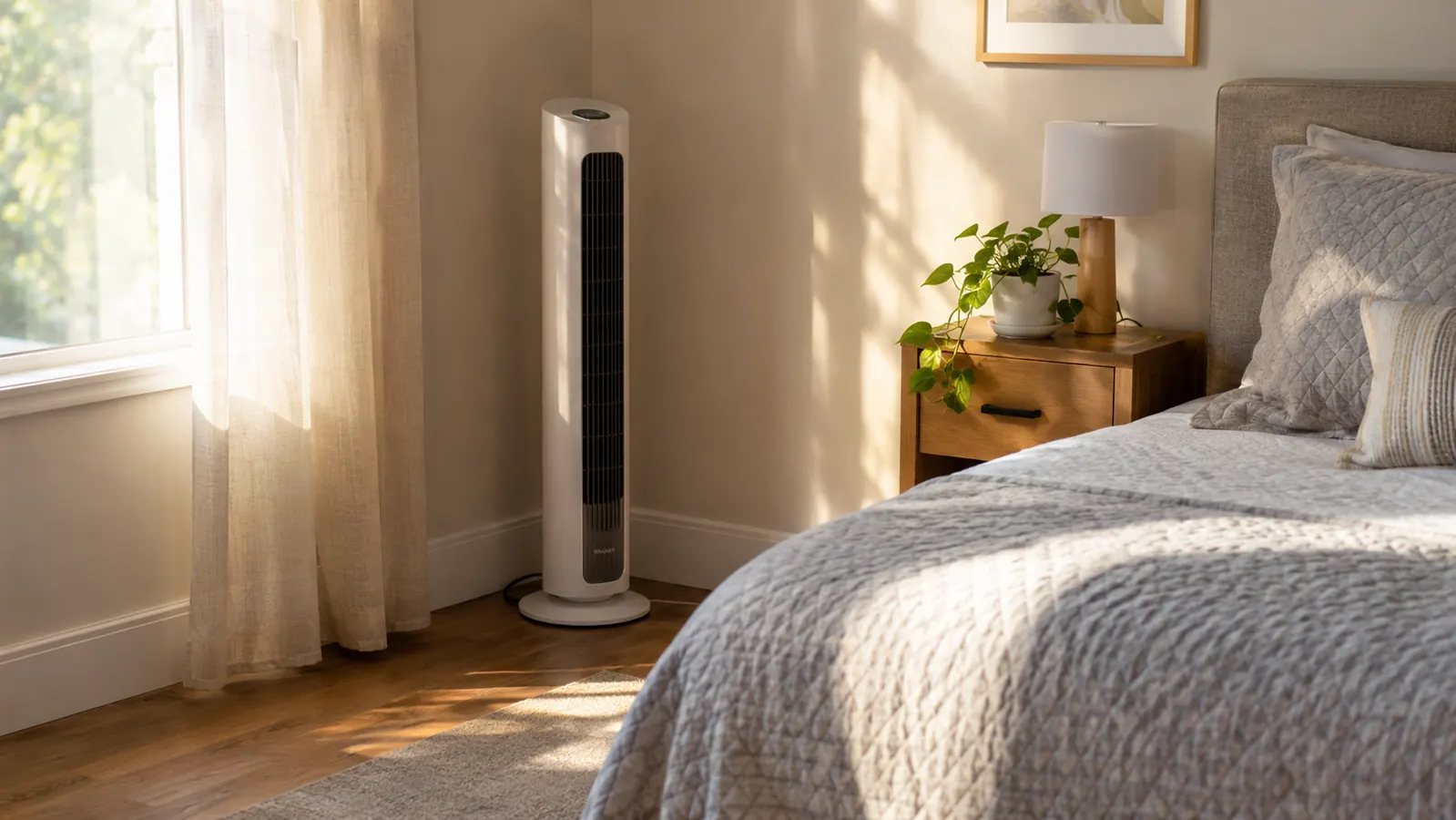
I use it during the day too. The bedroom faces west and bakes in the afternoon. In the summer I set the fan on high and point it at the bed for an hour before I go up, and the room is noticeably more comfortable by the time I get there. The central air does the heavy lifting. The fan does the fine-tuning.
The biggest surprise was Dennis. He runs cold, sleeps under a heavy blanket even in July, and I was sure the fan would become a wedge between us. Instead, the airflow is gentle enough that he barely feels it, and the white noise covers the sounds that used to wake us both. We both sleep better now. That is the real test, and it passed.
What I Liked
- Genuinely quiet on the low speeds, which is where bedroom use actually lives
- Remote with a magnet and a home, always where I can reach it in the dark
- Slow, smooth oscillation that covers the whole bed instead of one stripe
- Eight speeds from a whisper to a serious breeze, so there is a setting for every kind of night
- Steady motor, four months in with no rattling
Where It Falls Short
- The control panel glows when you touch it, bright enough to notice in a dark room
- Sleep mode drops the speed too aggressively, and I woke up hot the one night I tried it
- It is a floor unit, so it takes up space next to the bed and cannot be clipped or hung
Now I wake up hot, tap the remote up two speeds, feel the air move across my skin, and usually drift off again in a few minutes. That is not a cure. It is a real improvement in the quality of my nights.
Who This Is For
This fan is for anyone who wakes up hot in the night and has been making do with a ceiling fan that just stirs the warm air around. It is for women in perimenopause and menopause who are tired of the 3 a.m. sheet twist and want a tool that makes the bedroom easier to sleep in. It is for couples with opposite temperature needs, where one person wants airflow and the other wants a blanket. And it is for skeptics, because this is not a gadget with a phone app and a subscription. It is a fan that does one job quietly and well. If your bedroom is cool but the air goes dead around you, this is the fix.
Who Should Skip It
Skip it if you need total darkness and know a glowing control panel will drive you mad, unless you are willing to cover it with tape. Skip it if you want a fan you can clip to a headboard or set on a desk, because this is a floor unit and it claims real estate next to the bed. Skip it if you expect a fan to stop your hot flashes, because nothing does that, and anyone who promises otherwise is selling something. And please, if your night sweats are severe, sudden, or keeping you from functioning, talk to your doctor. A fan is comfort. It is not treatment, and I would never pretend otherwise.
The Bottom Line
If you are on the fence, here is my honest advice. Buy the fan, set it on speed three, keep the remote on your nightstand, and give it a week. If it does not make your nights easier, send it back. But I suspect you will find, like I did, that the quiet hum and the moving air become the new normal faster than you expect. Four months in, I cannot picture a summer night without it. That is the highest compliment a 3 a.m. wake-up can pay.
Four months of better nights, one quiet fan
If this sounds like the fix your 3 a.m. self has been looking for, check today's price on Amazon. I would buy it again tomorrow.
Amazon Check Today's Price on Amazon →