
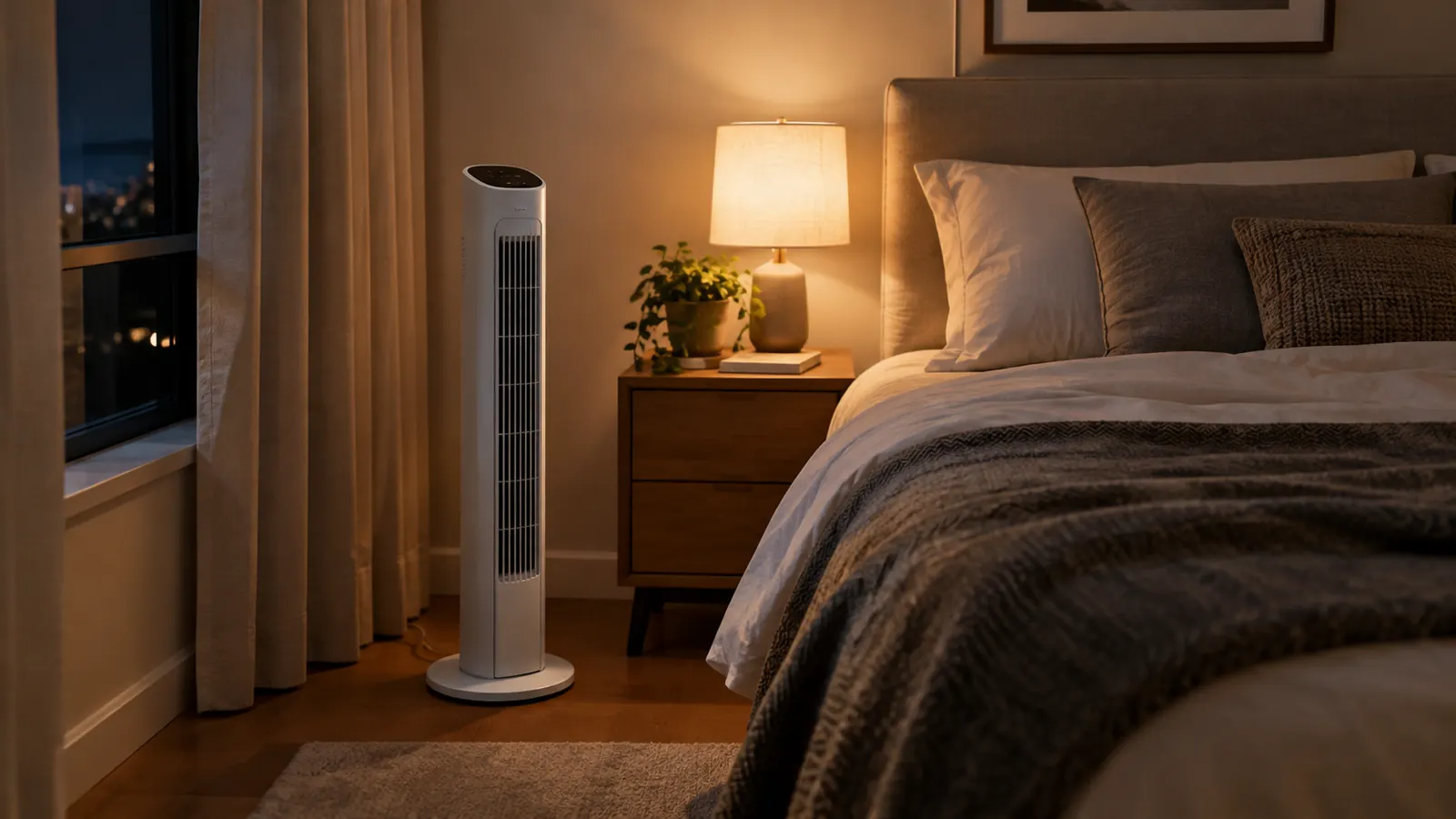
I bought the Dreo tower fan in early June, right before the first real heat wave of the summer, and I have run it almost every night since. That is about four months of 3 a.m. wake-ups, damp pillowcases, and one very patient husband who sleeps under a heavy blanket no matter what the thermostat says. I am 54, I have been dealing with night sweats for about three years, and I have tried a lot of things to make the bedroom cooler. Some of them worked. Most of them did not. This is the honest version of what happened when I put the Dreo on my side of the bed.
The Quick Verdict
The Dreo tower fan is the best cooling tool I have added to my bedroom in years, but it is not a cure for night sweats and it will not freeze you out. It moves a surprising amount of air for how quiet it is, the remote is genuinely useful at 3 a.m., and the oscillation covers our whole queen bed. It has limits: the lowest speeds are barely noticeable, the highest speed is loud enough to hear over a podcast, and the base is light enough that our cat-free, kid-free house has still managed to knock it over once. For the money, it is the first thing I would buy again.
Amazon Check Today's Price →If you wake up hot at night, this is the fan I would start with
I tested the Dreo tower fan for four months on my side of the bed. It is quiet enough to sleep through, strong enough to actually feel, and the remote means I do not have to sit up to change the speed. Check today's price on Amazon and see if it fits your bedroom setup.
Amazon Check Today's Price on Amazon →How I've Used It
Our bedroom is in a 1950s brick ranch in Asheville, and the room faces west. By five in the afternoon in July, the walls have been baking for hours, and even with the central air set to 68 at night, the room does not catch up until well after midnight. I have a queen bed, I sleep on the left side, and the Dreo has lived on that side, about two feet from the headboard, since the first week of June.
The Dreo was not my first attempt. In May I dragged the box fan out of the garage, the one Dennis uses when he is painting, and aimed it at the bed. It moved a lot of air, but the noise was relentless and the blast was so wide that Dennis asked me to turn it off two nights in a row. Then I tried a window fan in the west window, which pulled in hot air from the porch and made the room louder without making it cooler. It lasted one night before I carried it back to the hall closet. The Dreo was the fourth thing I tried, and it is the only one still in the room.
I use it on the oscillating setting almost every night, usually on speed 3. On the nights when I wake up already sweating, I reach for the remote on the nightstand and bump it to 5 for ten or fifteen minutes until I cool off, then drop it back down. Dennis, my husband, runs cold and keeps a flannel blanket on his side even in August, so the oscillation matters: it moves air across my side without turning his side into a wind tunnel.
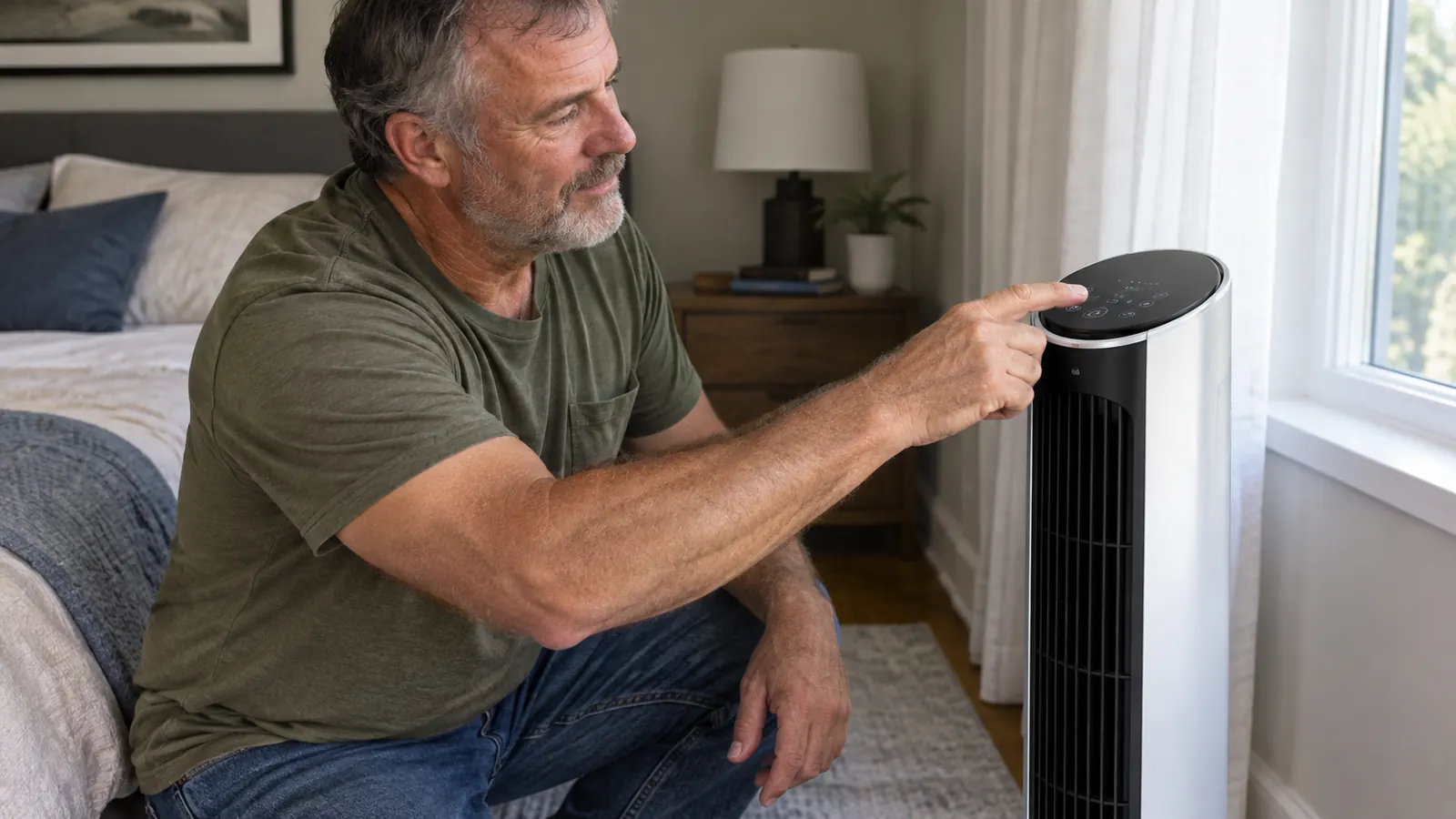
The remote is the feature I did not expect to care about. At 3 a.m., when I am half awake and my pajama top is stuck to my back, the last thing I want to do is sit up, find the buttons on the base in the dark, and fiddle with them. The remote lives on my nightstand, and I can change the speed, turn the oscillation on or off, and set the timer without opening my eyes. That sounds like a small thing. It is not a small thing at 3 a.m.
What Nobody Tells You Before You Buy a Tower Fan
The first thing nobody tells you is that tower fans are not box fans. A box fan sounds like a small airplane taking off, and it moves air in a wide, blunt blast. The Dreo is quieter, but the air is narrower and more focused. On the lower speeds, you have to be fairly close to it to feel much. On speed 1 or 2, I honestly cannot tell it is on unless I put my hand right in front of the grille. That is fine for white noise. It is not fine for cooling off.
The second thing nobody tells you is that the highest speeds are not whisper quiet. The marketing says quiet, and the lower speeds genuinely are. But on speed 8, there is a clear whoosh that I can hear over the central air and over Dennis's breathing. I do not mind it, because I only run it that high on hot afternoons, never at night. But if you are someone who needs absolute silence to fall asleep, you will want to know that before you buy.
The third thing is the base. The fan is tall and slim, and the base is not heavy. The first week I had it, I was changing the sheets and my elbow caught the top of the fan. It tipped over with a plastic clatter that I am pretty sure Dennis felt on his side of the bed. It did not break, and it has not happened since, but it is worth knowing: this is not a fan you want in a hallway where a dog or a grandkid might run into it. We have neither, and I still managed to knock it over once.
One more thing nobody tells you is how much the room around the fan matters. Our outlet is on the wall nearest the door, and the fan's cord reaches it, but just barely, so the fan sits exactly where the cord allows. That turns out to be the right distance from the bed anyway. And on the cool nights in late September, when the house finally drops below 70 on its own, I have learned to turn the fan off before I get in bed, because moving air on a cold night is its own kind of misery. The remote makes that easy too. I can shut it off from under the blanket without exposing a shoulder.
The Night It Earned Its Place
The night that convinced me was the second week of July. Asheville hit 94 degrees that day, and our bedroom, with the west-facing windows, still felt warm and stuffy at 10 p.m. even with the central air running. I went to bed already dreading the 2 a.m. wake-up. It came right on schedule. I woke up with my hair damp at the temples and the sheet twisted around my legs.
I reached for the remote, hit the button to take the Dreo from 3 to 5, and pointed it at my side of the bed. Within about ten minutes, the air moving across my arms and neck was enough that I stopped feeling the heat radiating off my own skin. I did not get cold. I did not stop sweating entirely. But the feeling of being trapped in my own body heat broke, and I fell back asleep. That is the honest bar for this fan: it does not stop the hot flash, but it makes the minutes after one survivable.
That night I also set the timer for the first time, twenty minutes, because I did not want to wake up cold at 4 a.m. The fan swept across my side of the bed, and I pulled the sheet up to my chin because the moving air was suddenly too cool on my damp skin. I remember looking at the clock on the nightstand: 2:47 a.m. I was asleep again before the timer clicked the fan off at 3:07. It was the first night all summer that I did not lie awake for an hour replaying the day while I waited to cool off. Dennis never even woke up, which I took as the highest compliment.
The Dreo does not stop the hot flash. It makes the minutes after one survivable, and on a 94-degree July night, that was enough to earn its spot on my side of the bed.
What I Changed in the Bedroom Alongside It
I made these changes in a specific order, and the order mattered. The sheets, the pillow and the topper each helped a little around the edges. The fan was the change that tied the whole setup together. Before I bought any of it, I had tried the usual things: a cold washcloth on the back of my neck, a glass of ice water on the nightstand, one memorable night when I tried sleeping with my hair in a wet bun. Those got me through individual nights, but they did not change the pattern. The fan did not change the pattern either, not really. What it did was make the hot minutes shorter, and that made everything else easier. By the end of August, I could feel the difference on the nights I forgot to turn it on.
The Dreo did not fix my sleep on its own, and I want to be honest about that. Alongside it, I swapped our sheets for a set of Bedsure PureWoven sheets in light gray, which are made from rayon derived from bamboo and feel noticeably cooler against the skin than the cotton set we had before. I put a QUTOOL cooling pillow on my side, the shredded memory foam kind with a zipper so I could pull some of the fill out. And I added a two-inch Linenspa gel memory foam topper under our fitted sheet, mostly because the mattress we have is older and the topper made the bed more comfortable overall.
I am not going to tell you that any of these things stopped my night sweats, because they did not. My night sweats are a menopause symptom, and I have talked to my doctor about them. A fan and a set of sheets are not a treatment. What they did, together, was make the bedroom a place where I could fall back asleep faster after I woke up hot. The Dreo is the piece of that setup I would replace first if it broke, because it is the one that actually moves air across my skin.
The Pros and Cons After Four Months
What I Liked
- The remote works from across the room and is the single best feature for 3 a.m. wake-ups
- The oscillation covers the full width of our queen bed, so Dennis stays under his blanket while I get the breeze
- The lower speeds are genuinely quiet, quiet enough to sleep through
- The timer is useful: I set it for 30 minutes when I am cooling down, and it turns itself off
- It is slim and tucks into the corner beside the nightstand without taking up floor space
- The air velocity on speeds 6 through 8 is strong enough to feel across the bed, not just right next to the fan
Where It Falls Short
- Speeds 1 and 2 are very gentle, best for cool nights rather than a hot flash
- Speed 8 is not whisper quiet, there is a clear whoosh that you will hear over the central air
- The base is light and the fan tips over if you bump it, which I did once changing the sheets
- The control panel only lights briefly when you touch it, so at night the remote is the easier way to change settings
- The sweep is moderate rather than wide, so you have to aim it carefully
Who This Is For
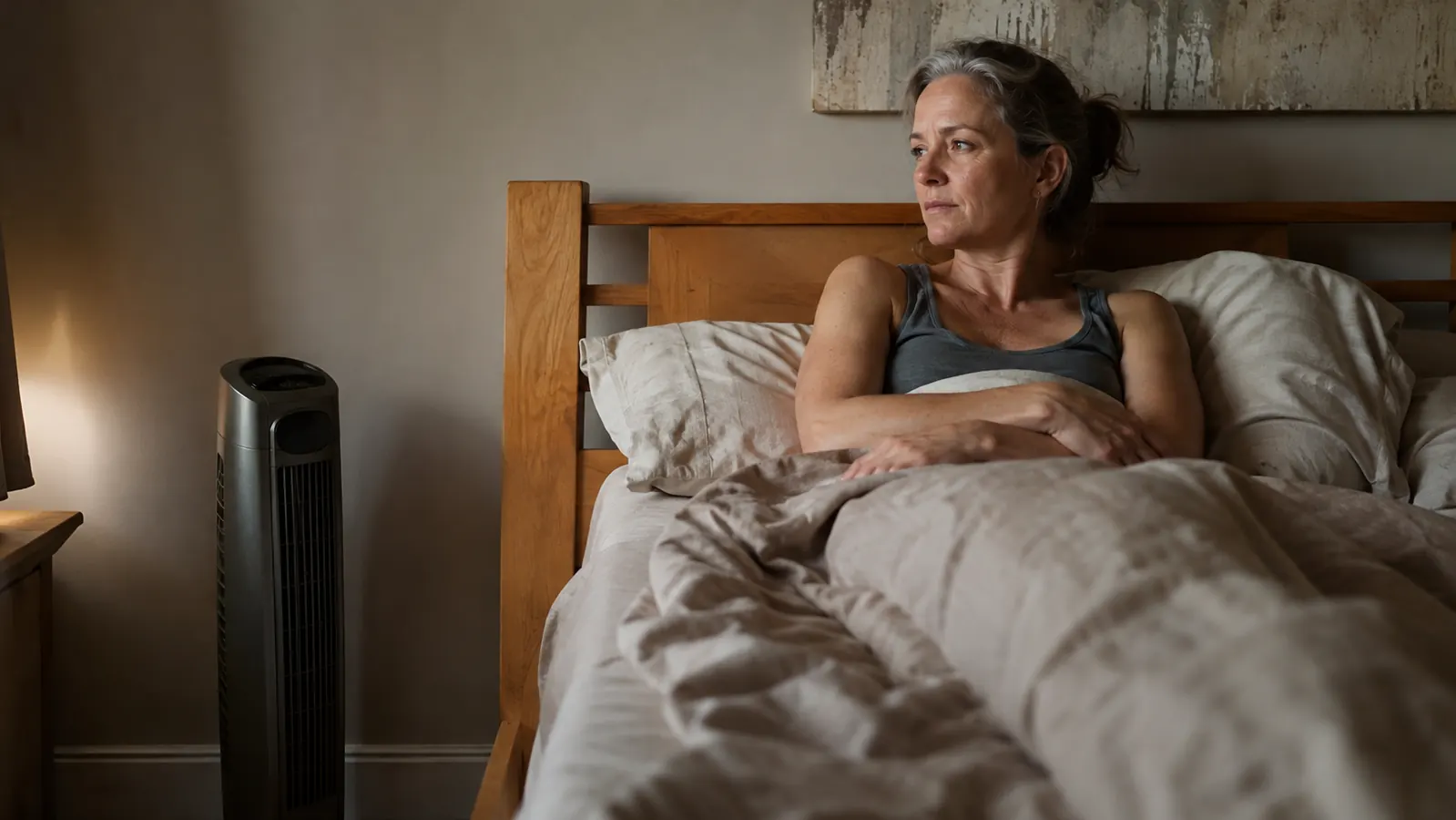
This fan is for the woman who wakes up at 3 a.m. with her hair stuck to her forehead and her pajama top damp, who has already tried opening the window, kicking off the blanket, and sleeping on top of the covers. It is for the woman who needs moving air on her side of the bed without turning the whole room into a wind tunnel that wakes up her husband. It is for the woman who does not want to sit up and fiddle with buttons in the dark, who wants a remote on the nightstand and a fan that can run all night without sounding like a lawnmower.
It is also for the woman who is skeptical of anything that promises to fix menopause with a gadget. The Dreo does not promise that. It is a fan. It moves air. If you are looking for something that will make the bedroom more comfortable on the nights when your own body is running hot, it does that job well. If you are looking for a cure for night sweats, no fan is that, and you should talk to your doctor.
Who Should Skip It
Skip the Dreo if you need a fan that is completely silent on every speed. The lower speeds are quiet, but the higher speeds have a clear whoosh, and if you are a light sleeper who cannot tolerate any fan noise, this is not the fan for you. Skip it if you need a fan with a heavy, stable base that can survive being bumped by pets or kids. The base is light, and it tipped over once when I caught it with my elbow. It did not break, but it is not built like a fortress.
Skip it if you are hoping for a dramatic, immediate drop in temperature. The Dreo moves air, and moving air makes your skin feel cooler, but it does not lower the temperature of the room. On a 94-degree night, the bedroom was still warm; the fan just made it bearable. And skip it if you already have a ceiling fan that moves plenty of air across your side of the bed. The Dreo is a meaningful upgrade for us because our ceiling fan is weak and the room holds the afternoon heat, but if your setup already works, you do not need this.
What I Wish I Had Known Before I Bought It
I wish someone had told me that the lowest speeds are basically a white noise machine and not a cooling fan. I spent the first two nights on speed 2, wondering why I was still hot, before I figured out that I needed speed 3 or higher for actual airflow. I wish someone had told me that the remote is the whole point. I almost bought a cheaper fan without a remote, and I am glad I did not, because the remote is the difference between a fan I use and a fan I would have stopped using after a week.
I also wish someone had told me that the fan needs a little space to work. I originally had it pushed back against the nightstand, and the airflow was noticeably weaker. When I moved it out about a foot from the furniture, the breeze across the bed improved a lot. That is the kind of detail that is not in the product photos, and it is the kind of detail that makes the difference between a fan that works and a fan that sits in the corner.
The Bottom Line
After four months of nearly every night, the Dreo tower fan is the piece of my cooling setup I would replace first. It is not perfect. The low speeds are weak, the high speed is not silent, and the base is light enough to tip. But the remote, the oscillation, and the air velocity on the middle speeds have made more difference to my sleep than any other single change I made this summer. I still wake up hot some nights. I still have night sweats. But I fall back asleep faster, and that is worth a lot at 3 a.m.
Four months in, this is the fan I would buy again
The Dreo tower fan has run almost every night since June on my side of the bed. It is not a cure for night sweats, but it is the best tool I have found for cooling down and getting back to sleep. Check today's price on Amazon and see if it is right for your bedroom.
Amazon Check Today's Price on Amazon →