
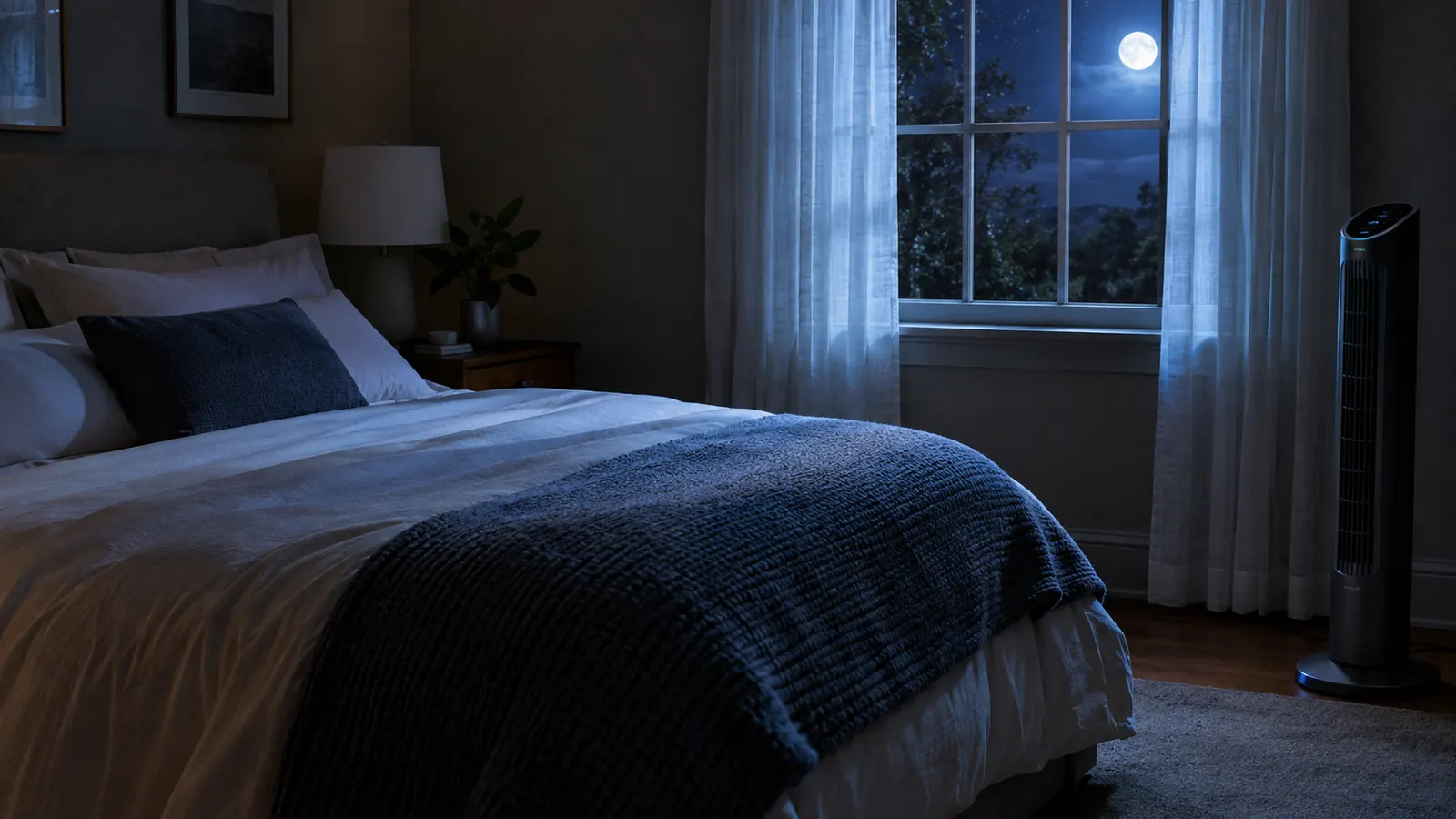
There is a particular kind of wake-up I know too well. It is 3 a.m., the room is dark, and my skin suddenly feels hot and damp. The sheet under me seems to be holding heat instead of letting it go. I kick it off, then I am cold, then I am hot again. Dennis sleeps right through it under his heavy blanket, and I lie there doing the math on how many hours of sleep I can still get before the alarm. Some nights I gave up and just read until dawn. It was on one of those nights, after a week of the same pattern, that I started paying real attention to what my bed was made of.
I won't promise that a set of sheets fixes night sweats. Nothing I've tried does that, and I'd be lying if I said otherwise. What I can tell you is that some bedding makes a hot night worse, and some makes it more bearable. After about four months of testing in my own bedroom, the setup that works for me starts with the Bedsure PureWoven sheets, queen size, made from rayon derived from bamboo. That sounds like a label, I know. I thought so too. But after sleeping on cotton, on a cheap microfiber set, and on these, the difference shows up in how often I wake up hot. The rest of this guide is the five steps I settled on, in the order that actually worked for me.
Start with the one change that did the most
Everything in this guide builds on the same foundation: the Bedsure PureWoven queen set, four pieces of rayon derived from bamboo. It is the single change that made the biggest difference in my own bed, and it is where I would start yours.
Amazon Check Today's Price on Amazon →Step 1: Swap your regular sheets for bamboo rayon
Bamboo sheets are not made of whole bamboo fibers in the way you might picture. Most of them, including this set, are made of rayon that starts as bamboo pulp, and the way that rayon is woven decides how the sheet behaves at 2 a.m. The Bedsure PureWoven line uses a weave that feels smooth and slightly crisp, closer to a good hotel sheet than to the slippery, silky feel of some bamboo sheets. That smooth, breathable weave is exactly what lets air move instead of trapping it. It is the closest thing to a plain cotton percale feel, only lighter.
Why does that matter on a hot night? Body heat has to go somewhere. A tightly woven sheet traps it against your skin, and before long you are lying in your own warmth with nowhere for it to go. A breathable weave lets it escape into the air above you, and that small difference is what keeps you from waking up with a damp spot under your shoulder. I noticed it the first night, not in a dramatic way, but in the way I stopped yanking the sheet off and pulling it back up. That was the first sign something was actually different.
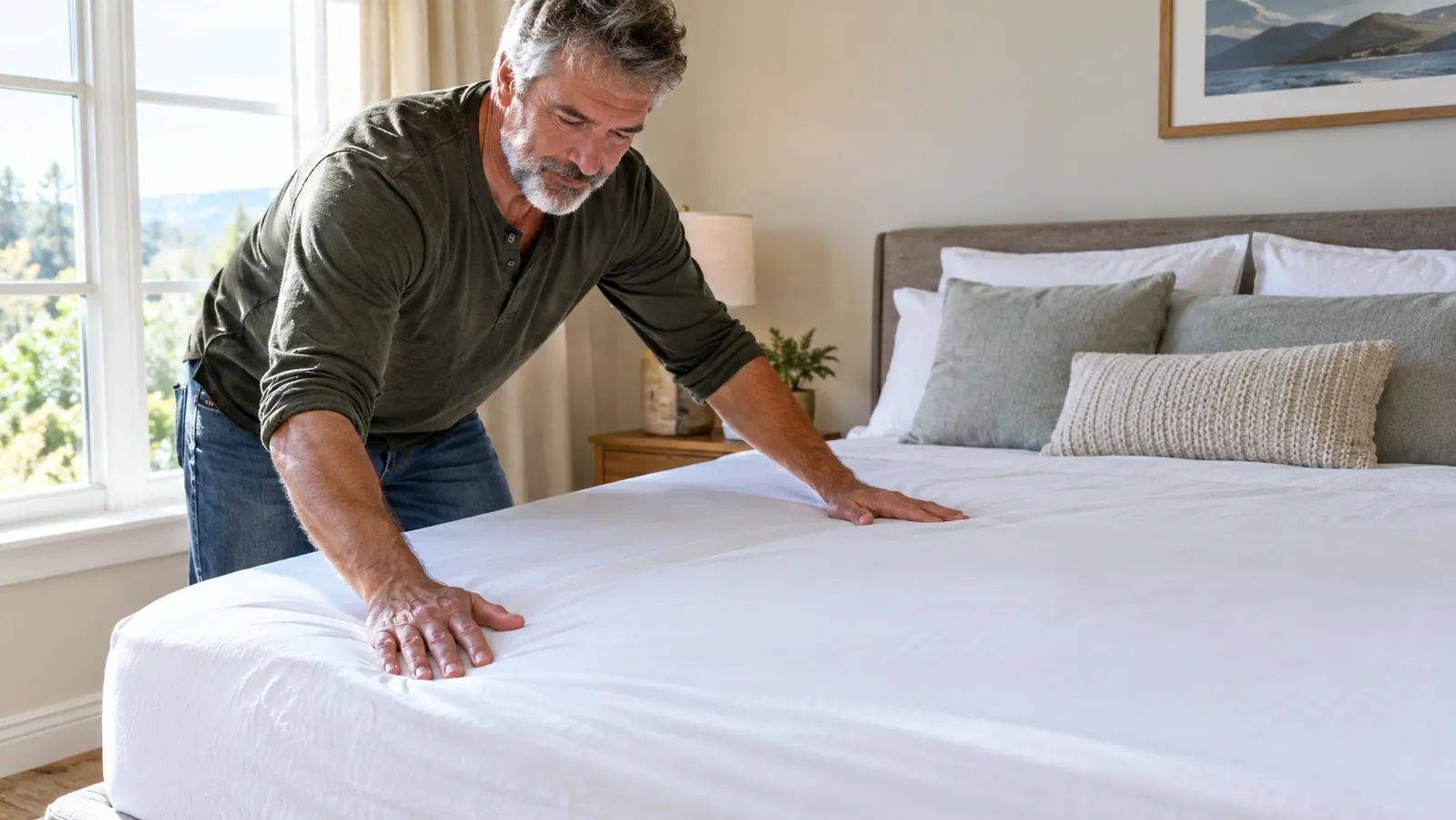
The set comes with four pieces: a fitted sheet, a flat sheet, and two pillowcases, in queen. Mine are light gray, and they still look as good as the day they arrived. That is everything you need to rebuild the bed, and the fitted sheet has deep pockets that stay put even with a mattress topper underneath. One note: skip any sheet that feels brushed or fuzzy on the surface. That soft nap holds heat. You want the smooth, breathable fabric.
Step 2: Rebuild the bed in layers you can shed
The second change was harder for Dennis than for me. He sleeps cold and wants a heavy blanket all year. I sleep hot and want nothing on me by 2 a.m. For years we fought over the covers, and one of us always lost. The fix was not one perfect blanket, because no single blanket can be right for both of us. The fix was layers, and letting go of the idea that a bed has to look like a magazine spread.
On my side, the top layer is just the flat sheet from the set, sometimes folded in half. Dennis keeps his heavy blanket on his side, and we have learned to live with a bed that does not match. Because we have separate top layers, one of us can sleep under a blanket while the other sleeps under a single sheet, and nobody has to choose between being cold and being drenched. It took me years to be okay with a bed that looks a little lopsided. It is worth it.
If you share a bed, start here. A fitted sheet, a light top layer, and one thin blanket folded at the foot for the 4 a.m. cold spell. The point is to be able to adjust without fully waking up, because once you are awake at 3 a.m., getting back to sleep is the real battle. I cannot count the nights I used to lose to a tug of war over a comforter. Now the only rule is that the top layers stay separate, and we both get the night we need.
Step 3: Wash them the way they want to be washed
Bamboo rayon is not hard to care for, but it rewards a little attention. I wash this set in cold water on the gentle cycle with a plain, mild detergent. I skip fabric softener entirely. Fabric softener coats the fibers, and on a sheet that is supposed to breathe, that coating works against you. The same goes for dryer sheets. If you want the fabric to keep moving air, keep it clean and uncoated.
I dry them on low heat, and when I have the time, I hang them on the line outside. Air drying keeps the weave open, and there is something about sheets that dried in the open air that makes the bed feel better in a way I cannot quite explain. If you use a dryer, pull them out while they are still slightly damp and smooth them onto the bed. They finish drying flat and wrinkle less, which means less ironing and a smoother surface to sleep on.
One thing that surprised me: these sheets got softer after a few washes. The first week they felt a little crisp, which I actually liked on hot nights. Now they are smooth without losing the breathability, which is the balance you are looking for. Wash them before the first use. The finish from the factory washes out, and the real fabric shows up after that. From then on, it is just cold water, low heat, and staying away from fabric softener.
Step 4: Move some air around the bed
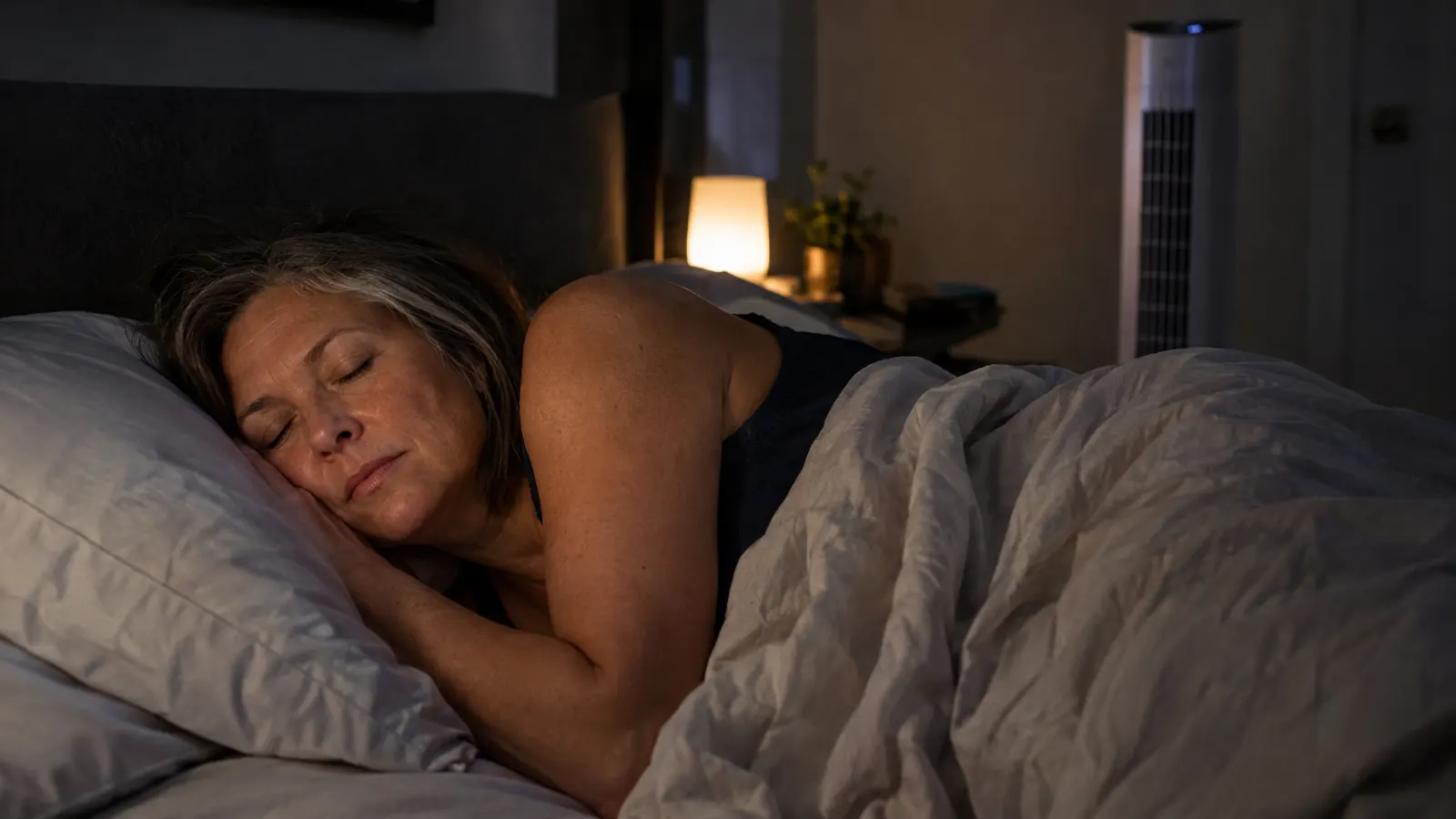
The sheets do their best work when the air above them is moving. Our bedroom faces west and holds the afternoon heat, so I close the curtains in the late afternoon and open the window for a few minutes before bed to let the warm air out. On my side of the bed, I run a tower fan on the floor. It is not pointed at my face. It is pointed across the bed, so the air moves over me without that harsh direct blast.
The fan has eight speeds and oscillates, and it has a remote, which matters more than it sounds like it should. I can adjust it without sitting up, and I can turn it down when I get cold without fumbling for a switch in the dark. I keep the thermostat around 68 at night. That number works for us, but the principle is the same for anyone: cool the air, then move it. Still air is the enemy. A slow, steady current of air across the bed makes a bigger difference than dropping the thermostat another degree.
You do not need an expensive fan to do this. A basic one aimed across the bed helps, and the noise of a fan is a comfort to some people anyway. Stagnant air holds heat close to your skin, and moving air carries it away. That is the whole trick, and it costs almost nothing compared to a new mattress. If white noise keeps you up, aim the fan away from your head or set it on a low speed.
Step 5: Do not ignore what is under you
Here is the part nobody talks about. Even with breathable sheets, your body heat has nowhere to go but down into the mattress, and a mattress that sleeps warm will undo a lot of good work. Ours is not new, and it sleeps warm. I added a two inch gel memory foam topper, the kind that sits on top of the mattress under the fitted sheet. It's not a fix on its own, and I won't pretend it made the bed feel cold. But it changed the surface, the fitted sheet goes over it exactly like normal, and the combination works better than either one alone.
I also swapped my pillow. I use a shredded memory foam pillow with a zipper, so the fill is adjustable. I took some out to get the loft where I want it, which I did not think I would care about, and now I do. A pillow that sits too high or too low makes me turn over more, and every turn is a chance to wake up. Dennis uses the other pillow from the same set, and he has stopped complaining about his, which for Dennis is a rave review.
A note on honesty: I can't give you a number of degrees cooler, and I wouldn't trust anyone who can. What I can tell you is that between the sheets, the layers, the moving air, and a pillow that does not fight me, I wake up less often with that hot, damp feeling. Some nights I still wake up hot. It happens. But I fall back asleep faster, and that is a real change. That is the whole point of all this.
What Else Helps
A few smaller things moved the needle. I sleep in a bamboo viscose pajama set now, long sleeves, a button front, and pants, which sounds backwards until you try it. The fabric breathes the way the sheets do, and I stay comfortable without waking up sweaty. I also keep a glass of cold water on the nightstand, and I close the curtains before the afternoon sun hits the west window. Little things, but they add up over the course of a week, and none of them require a big purchase.
And I will say the thing I say in every conversation about this: night sweats are worth talking to your doctor about. I did, and it was a relief to say it out loud to someone who could actually help. A sheet can make a hot night more bearable, but it is not treatment. If you are waking up hot most nights, or if it is wearing you down, bring it up at your next appointment. Comfort and medicine are two different tools, and you deserve both.
Four months in, the Bedsure sheets are the one change I would not undo. I still wake up hot some nights. I just do not wake up because my sheets are holding heat against my skin.
A cooler night is a series of small changes
Start with the sheets, layer the bed so you can shed, move some air, and deal with what is under you. None of it is complicated, and none of it is a cure. The Bedsure set is where I would begin, and I would give it a few weeks before you judge it.
Amazon Check Today's Price on Amazon →